Before you start your preparation, you have to go through the latest SSC CGL syllabus and exam pattern, which covers the entire course for the exam. This article serves as a comprehensive guide to the SSC CGL 2026 Tier 1 and Tier 2 syllabuses, covering each subject, the exam pattern, the marking scheme, special statistics papers for JSO posts, and general studies (finance and economics) for AAO posts.
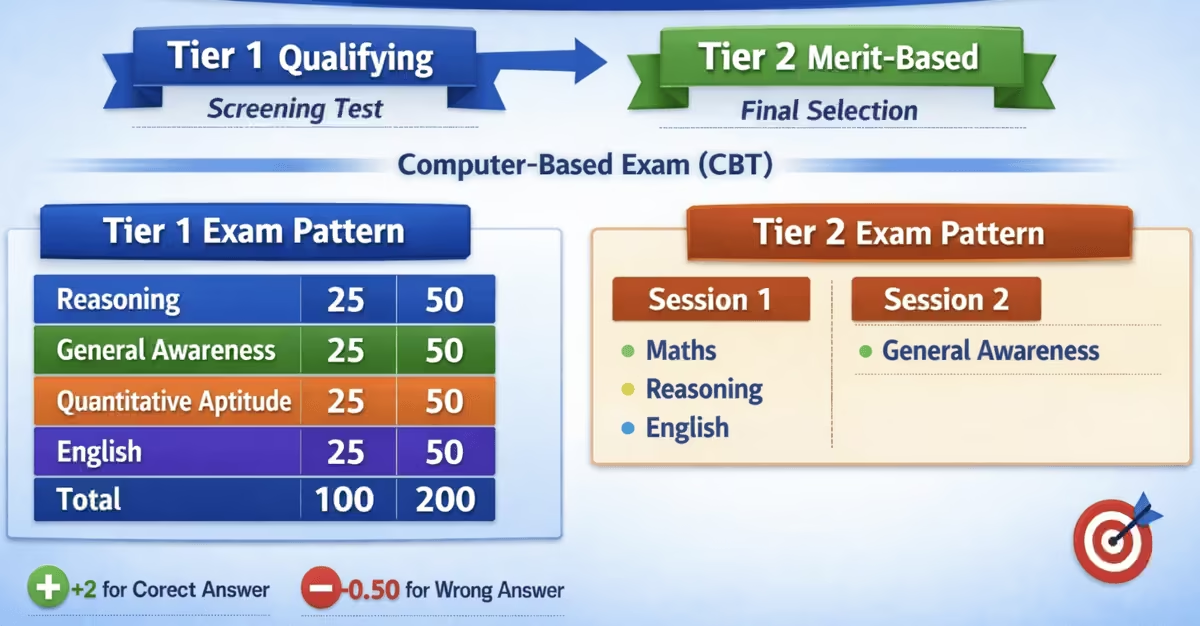
- Tier 1 exam includes 100 questions for 200 marks, while Tier 2 includes 200 questions for 450 marks. The negative marking is applicable for both stages.
- The Tier 1 exam is qualifying in nature and the final selection will done based on marks scored in Tier 2.
| SSC CGL Syllabus and Exam Pattern 2026- Overview | |
| Exam Name | SSC CGL 2026 |
| Types of Questions | Objective Type |
| Mode of Exam | Computer-Based Test (CBT) |
| Total Questions | Tier 1: 100 Tier 2: 150 |
| Total Marks | Tier 1: 200 Tier 2: 450 |
| Language | Bilingual — Hindi & English |
| Time Duration | Tier 1: 1 hour |
| Negative Marking | Tier 1: 0.50 Tier 2: Section 1 & 2: 1 mark |
| Selection Process | Tier 1, Tier 2, and Document Verification |
| Exam Level | National Level |
| Official website | www.ssc.gov.in |
Important – SSC has introduced sectional timing in both the Tier 1 and the Tier 2 exams. In Tier 1, 15 minutes is allotted for each subject, and in Tier 2, there is sectional timing in Paper 1. Full details are discussed in the article.
SSC CGL Selection Process 2026
There are two tiers of examination and document verification in the SSC CGL selection process. There is no interview round; your final selection is based only on marks scored in Tier 2.
| Tiers | Names | Nature |
| Tier 1 | Tier 1 (Prelims) | Qualifying |
| Tier 2 | Tier 2 (Mains) | Merit-Based |
| Document Verification | Mandatory | |
Are SSC Tier 1 marks added to final merit list?
No, SSC CGL Tier 1 is just qualifying and marks are not counted in final merit list.
SSC CGL Tier 1 Syllabus 2026
The Tier 1 exam consists of 4 subjects, each with 25 questions, totalling 100 questions and 200 marks, to be solved in 60 minutes with 15-minute sectional timing. Each wrong answer deducts 0.5 marks. Focus first on the easiest subjects to build your momentum. The Tier 1 syllabus for Reasoning, Quantitative, English and General Awareness is discussed below.
| Subjects | Questions/Marks | Timings |
| General Intelligence & Reasoning | 25/50 | 15 minutes |
| Quantitative Aptitude | 25/50 | 15 minutes |
| English Language | 25/50 | 15 minutes |
| General Awareness | 25/50 | 15 minutes |
| Total | 100/200 | 60 minutes |
Is there negative marking in SSC CGL Tier 1?
Yes, there will be deduction of 0.5 marks for each incorrect answer.
General Intelligence and Reasoning Syllabus
| Topics | Details | Expected No. of Questions |
| Classification | Finding the odd one out (semantic, symbolic, or number) | 1 to 2 |
| Analogy | Semantic, symbolic/number, and figural similarities | 3 to 4 |
| Series | Alphabet, word, and arithmetic number series | 3 to 4 |
| Syllogism & Statements | Statement-conclusion, assumptions, and logical inference | 2 |
| Venn Diagrams & Operations | Set theory logic, word building, and numerical operations | 1 to 2 |
| Coding-Decoding | Letter coding, number coding, and decoding logic | 2 to 3 |
| Blood Relations | Family tree problems and | 2 to 3 |
| Direction | Direction sense tests | 2 |
| Missing Number & Pattern | Missing term, wrong number in a series/pattern | 2 to 3 |
| Non-Verbal Series | Figural classification and completion of geometric patterns | 3 to 4 |
| Arithmetical Reasoning | Judgement, Descision making, problem solving | 1 to 2 |
Quantitative Aptitude Syllabus
| Topics | Details | Expected No. of Questions |
| Number System | Computation of whole numbers, decimals, fractions, relationships between numbers | 1-2 |
| Simplification | BODMAS-based calculation and approximation | 2-3 |
| Percentage, Profit & Loss | Percentage, Profit and Loss, discount | 3-4 |
| Ratio, Average & Mixture | Ratio & Proportion, averages, mixture and alligation, partnership | 3-4 |
| Simple & Compound Interest | Interest-based calculations | 2-3 |
| Time, Speed & Distance | Time and distance-based problems | 2 |
| Time & Work | Work efficiency, pipes and cisterns | 2 |
| Algebra | Basic algebraic identities, elementary surds, graphs of linear equations | 2-3 |
| Geometry | Triangles, circles, quadrilaterals, congruence and similarity | 3-4 |
| Trigonometry | Trigonometric ratios, standard identities, heights and distances | 2-3 |
| Mensuration | Area/volume of prism, cone, cylinder, sphere, pyramid, hemisphere | 2-3 |
| Statistics & Data Interpretation | Histogram, frequency polygon, bar diagram, pie chart | 3-4 |
English Language Syllabus
| Topics | Details | Expected No. of Questions |
| Reading Comprehension | Passage-based questions on comprehension and inference | 5 |
| Cloze Test | Fill-in-the-blank passage | 5 |
| Error Detection | Spot the error/grammatical mistakes | 4-5 |
| Sentence Improvement | Sentence correction, active/passive, direct/indirect narration | 2-3 |
| Fill in the Blanks | Vocabulary and grammar-based blanks | 2-3 |
| Synonyms & Antonyms, | Vocabulary-based word meaning | 2 |
| Idioms and Phrases | Idiomatic expression meaning | 2 |
| One Word Substitution | Single word for a phrase/sentence | 1-2 |
| Spelling/Misspelt Words | Detecting incorrectly spelled words | 1 |
General Awareness Syllabus
| Topics | Details | Expected No. of Questions |
| Current Affairs | National/international events from the last 6-8 months, India and its neighbouring countries | 4-5 |
| History | Ancient, medieval, and modern Indian history | 3-4 |
| Polity & Constitution | Indian Constitution, governance, political system | 3-4 |
| Geography | Physical, Indian, and world geography, environment | 3 |
| Economy | Economic basics, Union Budget, government schemes | 3 |
| Science | Physics, Chemistry, Biology | 4-5 |
| Static GK | Important Days, Books and Authors, National Organisations, Festivals and Dance Forms | 2-3 |
SSC CGL Tier 2 Syllabus 2026
Tier 2 is the merit-determining stage — your performance here decides which post you get. Paper I is compulsory for all candidates and is conducted in two sessions on the same day. candidates to qualify for all the sections of Paper I separately; Paper II (Statistics) is only for candidates applying for the Junior Statistical Officer (JSO) post.
Tier 2 Exam Pattern 2026
| Paper | Section/Module | Subject | Questions | Marks | Duration |
| Paper 1 | Section 1 | Mathematical Abilities | 30 | 180 | 30 minutes |
| Reasoning & General Intelligence | 30 | 30 minutes | |||
| Section 2 | English Language & Comprehension | 45 | 210 | 40 minutes | |
| General Awareness | 25 | 20 minutes | |||
| Section 3 | Computer Knowledge | 20 | 60 | 15 minutes | |
| Section 4 | Data Entry Speed / Typing Test | — | 30 (qualifying) | 15-minute | |
| Paper II | — | Statistics | 100 | 200 | 2 hours |
| Paper-III | — | General Studies (Finance and Economics) | 100 | 200 | 2 hours |
Key Details for SSC CGL Tier 2-
- Paper-I is compulsory for all the posts.
- Paper-II will be for only those candidates who have applied and shortlisted for the posts of Junior Statistical Officer (JSO).
- Paper-III will be for only those candidates who are shortlisted in Tier-I for the posts of Assistant Audit Officer/Assistant Accounts Officer.
Q- What is the qualifying speed for DEST?
For SSC CGL, the Data Entry Speed Test (DEST) is 8,000 key depressions per hour. Approximately 2,000 key depressions to be typed in 15 minutes, which is equal to 26 to 27 words per minute (WPM).
Module 1 of Session 1 of Paper I (Mathematical Abilities)
| Topics | Sub-topics |
| Number Systems |
|
| Fundamental arithmetical operations |
|
| Algebra |
|
| Geometry |
|
| Mensuration | |
| Trigonometry |
|
| Statistics and probability |
|
Module 2 of Session-1 of Paper-1 (Reasoning and General Intelligence):
Questions of both verbal and non-verbal types. These will include questions on
- Semantic Analogy
- Symbolic operations, symbolic/number analogy, Trends
- Figural Analogy
- Space Orientation
- Semantic Classification
- Venn Diagrams
- Symbolic/Number
- Classification
- Drawing inferences
- Figural Classification
- Punched hole/pattern-folding & unfolding
- Semantic Series
- Figural Patternfolding and completion
- Number Series
- Embedded figures
- Figural Series
- Critical Thinking
- Problem-Solving
- Emotional Intelligence
- Word Building
- Social Intelligence
- Coding and decoding
- Numerical operations
- Other sub-topics, if any.
Module 1 of Session 2 of Paper 2 (English Language And Comprehension):
- Vocabulary
- English Grammar
- Sentence structure
- Spot the Error
- Fill in the Blanks
- Synonyms/Homonyms
- Antonyms
- Spellings/Detecting misspelt words
- Idioms & Phrases
- One-word substitution
- Improvement of Sentences
- Active/Passive Voice of Verbs
- Conversion into direct/indirect narration
- Shuffling of sentence parts
- Shuffling of sentences in a passage
- Cloze Passage
- Comprehension Passage: Three or more paragraphs (at least one literary/story-based, others current affairs/editorial-based)
Module-I of Section-III of Paper-I (Computer Proficiency)
- Computer Basics: Organisation of a computer, CPU, input/output devices, memory, backup devices, ports, Windows Explorer, keyboard shortcuts
- Software: Windows OS basics, MS Word, MS Excel, PowerPoint
- Internet and e-mails: Web browsing & searching, downloading & uploading, managing an e-mail account, e-banking
- Networking and cybersecurity: Networking devices and protocols, network and information security threats (like hacking, viruses, worms, Trojans, etc.) and preventive measures
Module-II of Section-II of Paper-I (General Awareness)
- India and its neighbouring countries, especially in history, culture, geography, economic scene, general policy & scientific research
- Science
- Current Affairs
- Books and Authors
- Sports
- Important Schemes
- Important Days & Dates
- Portfolio
- People in News
Paper 2: Statistics Syllabus for JSO Posts
Paper II (Statistics) is only for candidates applying for the post of Junior Statistical Officer (JSO). This is an advanced paper that requires conceptual clarity and repeated revision. Focus on getting each chapter’s fundamentals right before moving on to complex topics like sampling theory and statistical inference.
| Subjects | Topics |
| 1. Collection, Classification and Presentation of Statistical Data | Primary and secondary data, methods of data collection, tabulation of data, graphs and charts, frequency distributions, and diagrammatic presentation of frequency distributions. |
| 2. Measures of Central Tendency | Common measures of central tendency – mean, median and mode; partition values – quartiles, deciles, percentiles. |
| 3. Measures of Dispersion – Common measures of Dispersion | range, quartile deviations, mean deviation and standard deviation: measures of relative dispersion. |
| 4. Moments, Skewness and Kurtosis | Different types of moments and their relationship; the meaning of skewness and kurtosis; and different measures of skewness and kurtosis. |
| 5. Correlation and Regression | Scatter diagram; simple correlation coefficient; simple regression lines; Spearman’s rank correlation; measures of association of attributes; multiple regression; multiple and partial correlation (for three variables only). |
| 6. Probability Theory | Meaning of probability, different definitions of probability, conditional probability, compound probability, independent events, and Bayes’ theorem. |
| 7. Random Variable and Probability Distributions | Random variable; probability functions; expectation and variance of a random variable; higher moments of a random variable; binomial, Poisson, normal and exponential distributions; joint distribution of two random variables (discrete). |
| 8. Sampling Theory | Concept of population and sample; parameter and statistic; sampling and non-sampling errors; probability and non-probability sampling techniques (simple random sampling, stratified sampling, multistage sampling, multiphase sampling, cluster sampling, systematic sampling, purposive sampling, convenience sampling and quota sampling); sampling distribution (statement only); sample size decisions. |
| 9. Statistical Inference | Point estimation and interval estimation; properties of a good estimator; methods of estimation (moments method, maximum likelihood method, and least squares method); testing of hypotheses; basic concept of testing; small sample and large sample tests; tests based on Z, t, chi-square and F statistics; and confidence intervals. |
| 10. Analysis of Variance | Analysis of one-way classified data and two-way classified data. |
| 11. Time Series Analysis | Components of time series, determination of trend component by different methods, and measurement of seasonal variation by different methods. |
| 12. Index Numbers | Meaning of index numbers, problems in their construction, types of index numbers, different formulae, base shifting and splicing of index numbers, cost of living index numbers, and uses of index numbers. |
Paper 3: General Studies (Finance and Economics) for AAO Posts
| Subjects | Topics |
| Part A: Finance and Accounts (80 marks) | |
| Financial Accounting | Financial Accounting: Nature and scope, limitations of financial accounting, basic concepts and Conventions, Generally Accepted Accounting Principles |
| Basic concepts of accounting | Basic concepts of accounting: single and double entry, books of original Entry, bank reconciliation, Journal, ledgers, trial balance, rectification of errors, manufacturing, trading, profit & loss Appropriation Accounts, Balance Sheet Distinction between capital and revenue expenditure, depreciation accounting, valuation of inventories, non-profit organisations’ accounts, receipts and payments and income & expenditure accounts, bills of exchange, and self-balancing ledgers. |
| Part B: Economics and Governance (120 marks) | |
| Comptroller & Auditor General of India | Constitutional provisions, role and responsibility. |
| Finance Commission | Role and functions |
| Basic Concept of Economics and Introduction to Microeconomics | Definition, scope and nature of economics; methods of economic study; central problems of an economy; and production possibilities curve. |
| Theory of Demand and Supply | Meaning and determinants of demand, law of demand and elasticity of demand, price, income and cross-elasticity; theory of consumer’s behaviour – Marshallian approach and indifference curve approach, meaning and determinants of supply, law of supply and elasticity of supply. |
| Theory of Production and Cost | This section covers the meaning and factors of production, as well as the laws of production, including the law of variable proportions and the laws of returns to scale. |
| Forms of market and price determination in different markets: | Various forms of markets – perfect competition, monopoly, monopolistic competition and oligopoly – and price determination in these markets. |
| Indian Economy | Nature of the Indian Economy: Role of different sectors – agriculture, industry and services – their problems and growth. National Income of India- Concepts of national income and the different methods of measuring it. Population: Its size, rate of growth and its implications for economic growth. Poverty and unemployment: Absolute and relative poverty, types, causes and incidence of unemployment. Infrastructure: energy, transportation, and communication. |
| Economic Reforms in India | Economic reforms since 1991: liberalisation, privatisation, globalisation and disinvestment. |
| Money and Banking | Monetary/Fiscal Policy – Role and Functions of the Reserve Bank of India: functions of commercial banks/ RRBs/payment banks Budget and fiscal deficits and balance of payments. Fiscal Responsibility and Budget Management Act, 2003 |
| Role of Information Technology in Governance. | |
SSC CGL Syllabus PDF Download (NEW)
The attached syllabus PDF for the SSC CGL 2026 exam includes both Tier 1 and Tier 2 exams. Download the latest SSC CGL syllabus PDF and prepare accordingly.



 Bihar Librarian Syllabus 2026, Exam Patt...
 MP Police Constable Syllabus 2026, Exam ...
 UPESSC Assistant Professor Syllabus 2026...