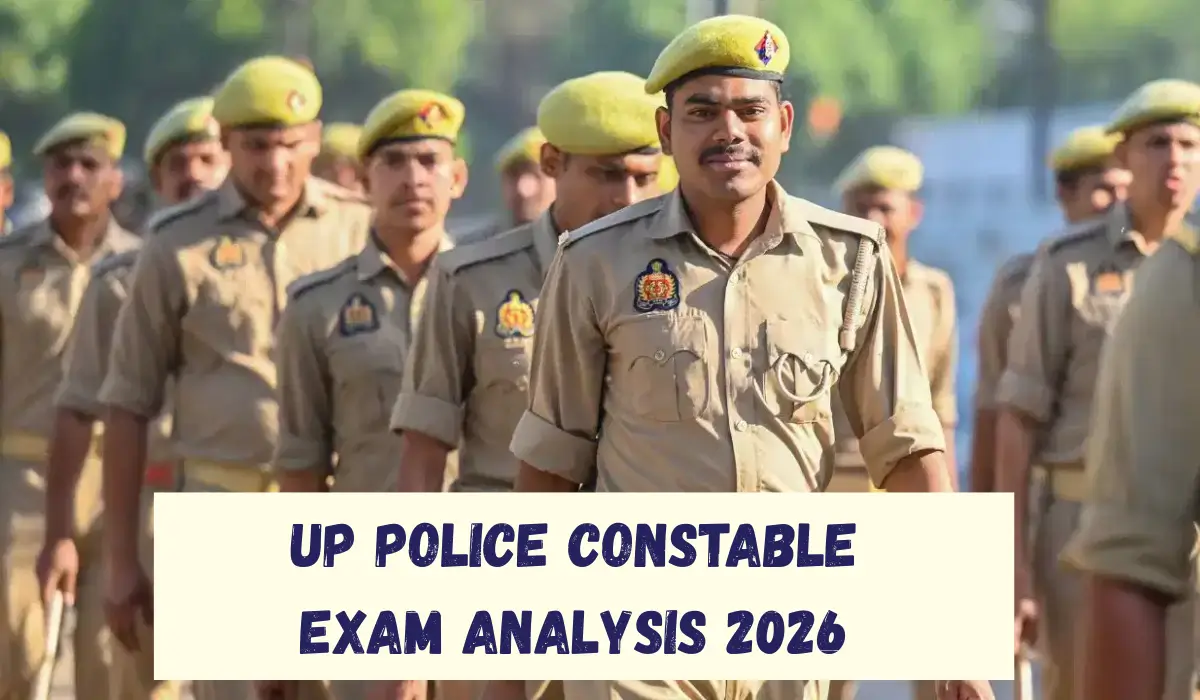
After the completion of today’s 1st shift of UP Police Constable exam, candidates who have their exam in the next shift must be looking for the type of questions asked, difficulty level, good attempts and any change from previous papers. To help you understand all aspects, we have prepared the UP Police Constable Exam Analysis 2026 based on the feedback shared by candidates who appeared in the 1st shift.
UP Police Exam Analysis 2026 Difficulty Level
The overall difficulty level of today’s UP Police Constable Exam was easy to moderate, with general knowledge, numerical and mental ability of moderate level.
| Sections | Difficulty Level |
| General Knowledge | Moderate |
| General Hindi | Easy to Moderate |
| Numerical and Mental Ability | Moderate |
| Mental Aptitude, IQ, and Logical Ability | Easy to Moderate |
| Overall | Easy to Moderate |
UP Police Constable Exam Analysis 2026 — 8th June (Day 1)
The first day of the UP Police Constable Exam 2026 has been conducted today. Based on the feedback from candidates who came out of the exam hall after Shift 1, here is what we know:
| Sections | No. of Questions | Good Attempts |
| General Knowledge | 38 | 30 – 33 |
| General Hindi | 37 | 33 – 35 |
| Numerical and Mental Ability | 38 | 30 – 34 |
| Mental Aptitude, IQ, and Logical Ability | 37 | 31 – 33 |
| Toral | 150 | 124 – 135 |
UP Police Constable Section-Wise Analysis 2026
1. General Hindi
The general Hindi section was reported to be the highest-scoring section of today’s paper. Most candidates who appeared found it easier compared to other sections.
- Grammar (Vyakaran) — Sandhi, Samas, Karak: 8 to 10 questions
- Vocabulary — Paryayvachi, Vilom, Muhavare: 6 to 8 questions
- Error Detection & Sentence Correction: 5 to 6 questions
- Filling in the Blanks: 4 to 5 questions
- One Word Substitution: 3 to 4 questions
- Reading Comprehension: 4 to 5 questions
2. General Knowledge & Current Affairs
The General Awareness / Law & Constitution section typically covers constitutional amendments, IPC acts, major legal cases, state administration, and current affairs. This section tends to be the most unpredictable and is what separates high scorers from average ones.
- UP-specific Current Affairs: 6–8 questions
- Indian Polity & Constitution: 5–7 questions
- History (Ancient, Medieval, Modern): 4–5 questions
- Geography — India & UP: 4–5 questions
- Science & Technology: 3–4 questions
- Sports, Awards, Appointments: 3–4 questions
- Schemes — Central & State Government: 3–4 questions
- Economy & Budget: 2–3 questions
3. Numerical & Mental Ability
The Numerical Ability section was reported to be moderately difficult with a few calculative questions that required time. Candidates with strong arithmetic fundamentals found this manageable.
- Simplification / BODMAS: 5–6 questions
- Percentage, Profit & Loss: 4–5 questions
- Ratio & Proportion: 3–4 questions
- Time, Speed & Distance: 3–4 questions
- Simple & Compound Interest: 3–4 questions
- Number System: 3–4 questions
- Average & Mixtures: 2–3 questions
- Data Interpretation: 3–5 questions
4. Reasoning Ability
The Reasoning section was well-balanced. Puzzles and series-based questions appeared in moderate numbers, while Coding-Decoding and Blood Relations were reported to be straightforward.
- Analogy: 5–6 questions
- Coding–Decoding: 4–5 questions
- Series (Number/Alphabet): 4–5 questions
- Blood Relations: 3–4 questions
- Direction Sense: 3–4 questions
- Syllogism: 3–4 questions
- Venn Diagram: 2–3 questions
- Non-Verbal Reasoning: 3–4 questions


 SSC CGL Exam Analysis 2026, Check 8 Octo...
 SBI Clerk Prelims 27 September Exam Anal...
 SBI Clerk Shift 3 Exam Analysis 2026, Go...