
RRB NTPC Syllabus 2026, CBT 1 & CBT 2 Subject-wise Topics
- Home
- RRB NTPC Syllabus
The Railway Recruitment Board (RRB) has officially released the RRB NTPC syllabus for both graduate-level and undergraduate-level posts. This page covers the complete subject-wise syllabus, updated exam pattern, topic-wise weightage for CBT 1 and CBT 2, Typing Skill Test requirements, and preparation tips.
RRB NTPC Syllabus 2026- Overview
The RRB NTPC exam is conducted in two stages: CBT 1 and CBT 2, and covers three subjects: General Awareness, Mathematics, and General Intelligence & Reasoning. While the syllabus subjects are the same for both CBT 1 and CBT 2, the number of questions and difficulty level differ between the two stages. The Graduate and Undergraduate level exams also follow the same subject syllabus, but the Graduate level has a higher difficulty standard.
| Detail | Information |
| Selection Process |
|
| Exam Subjects | General Awareness, Mathematics, General Intelligence & Reasoning |
| Mode of Exam | Online (Computer-Based Test) |
| CBT 1 Pattern | 100 Questions / 100 Marks / 90 Minutes |
| CBT 2 Pattern | 120 Questions / 120 Marks / 90 Minutes |
| Negative Marking | Yes – 1/3rd mark per wrong answer |
| Language of Exam | 15 languages including Hindi & English |
RRB NTPC Notification 2026 Out for 5236 Vacancies- Click to Check
RRB NTPC Syllabus 2026
The RRB NTPC syllabus is the same for both CBT 1 and CBT 2, but the number of questions and difficulty level differ across the two stages. A total of 100 questions are asked in CBT 1 and 120 questions in CBT 2. All questions are objective-type MCQs from three subjects: Mathematics, General Intelligence & Reasoning, and General Awareness.
1. Mathematics Syllabus
- Number System
- Decimals
- Fractions
- LCM, HCF
- Ratio and Proportions
- Percentage
- Mensuration
- Time and Work
- Time and Distance
- Simple and Compound Interest
- Profit and Loss
- Elementary Algebra
- Geometry and Trigonometry
- Elementary Statistics
2. General Intelligence & Reasoning Syllabus
- Analogies
- Completion of Number and Alphabetical Series
- Coding and Decoding
- Mathematical Operations
- Similarities and Differences
- Relationships
- Analytical Reasoning
- Syllogism
- Jumbling
- Venn Diagrams
- Puzzle
- Data Sufficiency
- Statement- Conclusion, Statement- Courses of Action
- Decision Making
- Maps
- Interpretation of Graphs
3. General Awareness Syllabus
RRB NTPC GK GS questions will be asked from the following topics.
- Current Events of National and International Importance (Current Affairs)
- Games and Sports
- Art and Culture of India
- Indian Literature
- Monuments and Places of India
- General Science and Life Science (up to 10th CBSE)
- History of India and Freedom Struggle
- Physical, Social and Economic Geography of India and the World
- Indian Polity and Governance- constitution and political system
- General Scientific and Technological Developments, including the Space and Nuclear Program of India
- UN and Other Important World Organizations
- Environmental Issues Concerning India and the World at Large
- Basics of Computers and Computer Applications
- Common Abbreviations
- Transport Systems in India
- Indian Economy
- Famous Personalities of India and the World
- Flagship Government Programs
- Flora and Fauna of India
- Important Government and Public Sector Organisations of India
- Current GK
RRB NTPC Topic-wise Weightage
Based on previous year question papers, the following topic-wise weightage is expected for the upcoming RRB NTPC exam.
Mathematics Weightage
| Topics | Questions (CBT 1) | Questions (CBT 2) |
| Number System | 3-4 | 4-5 |
| Simplification | 2-3 | 3-4 |
| Decimals & Fractions | 1-2 | 2-3 |
| LCM & HCF | 1-2 | 2-3 |
| Ratio and Proportion | 2-3 | 3-4 |
| Percentage | 2-3 | 3-4 |
| Mensuration | 2-3 | 3-4 |
| Time and Work | 1-2 | 2-3 |
| Time and Distance | 1-2 | 2-3 |
| Simple & Compound Interest | 2-3 | 3-4 |
| Profit and Loss | 2-3 | 3-4 |
| Elementary Algebra | 1-2 | 2-3 |
| Geometry & Trigonometry | 1-2 | 2-3 |
| Elementary Statistics | 1 | 1-2 |
| Data Interpretation (DI) | 1 | 2-3 |
Reasoning Weightage
| Topics | Questions (CBT 1) | Questions (CBT 2) |
| Analogies | 3-4 | 4-5 |
| Number & Alphabet Series | 2-3 | 3-4 |
| Coding-Decoding | 3-4 | 4-5 |
| Mathematical Operations | 2-3 | 3-4 |
| Similarities & Differences | 1-2 | 2-3 |
| Relationships (Blood Relations) | 1-2 | 2-3 |
| Analytical Reasoning | 2-3 | 3-4 |
| Syllogism | 1-2 | 2-3 |
| Jumbling | 1 | 1-2 |
| Venn Diagrams | 1-2 | 2-3 |
| Puzzle | 2-3 | 3-4 |
| Data Sufficiency | 1 | 1-2 |
| Statement-Conclusion | 1-2 | 2-3 |
| Decision Making | 1 | 1-2 |
| Maps & Interpretation of Graphs | 1 | 1-2 |
General Awareness Weightage
| Topics | Questions (CBT 1) | Questions (CBT 2) |
| Current Events (National & International) | 10-12 | 12-15 |
| History of India | 5-6 | 6-8 |
| Geography (India & World) | 3-4 | 4-5 |
| Indian Polity & Governance | 2-3 | 3-4 |
| Indian Economy | 2-3 | 3-4 |
| General Science (Physics, Chemistry, Biology) | 7-8 | 8-10 |
| Art & Culture of India | 1-2 | 2-3 |
| Indian Literature | 1 | 1-2 |
| Monuments & Places of India | 1 | 1-2 |
| General Scientific & Technological Developments | 2-3 | 3-4 |
| UN and Other Important World Organizations | 1 | 1-2 |
| Environmental Issues | 1 | 1-2 |
| Basics of Computers & Applications | 2-3 | 3-4 |
| Famous Personalities | 1-2 | 2-3 |
| Static GK (various topics) | 5-7 | 7-9 |
RRB NTPC Exam Pattern 2026
The RRB NTPC exam pattern for CBT 1 and CBT 2 is discussed below
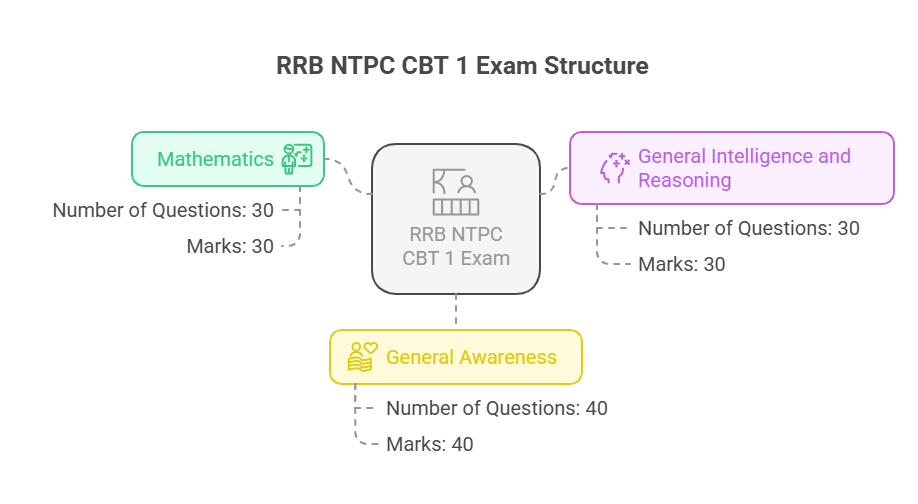
CBT 1 Exam Pattern
- Mode: Online (Computer-Based Test)
- Type of Questions: Objective Type MCQs
- Total Questions: 100
- Total Marks: 100
- Negative Marking: 1/3rd mark deducted per wrong answer
- CBT 1 marks are NOT counted in the final merit list — it is only a screening exam.
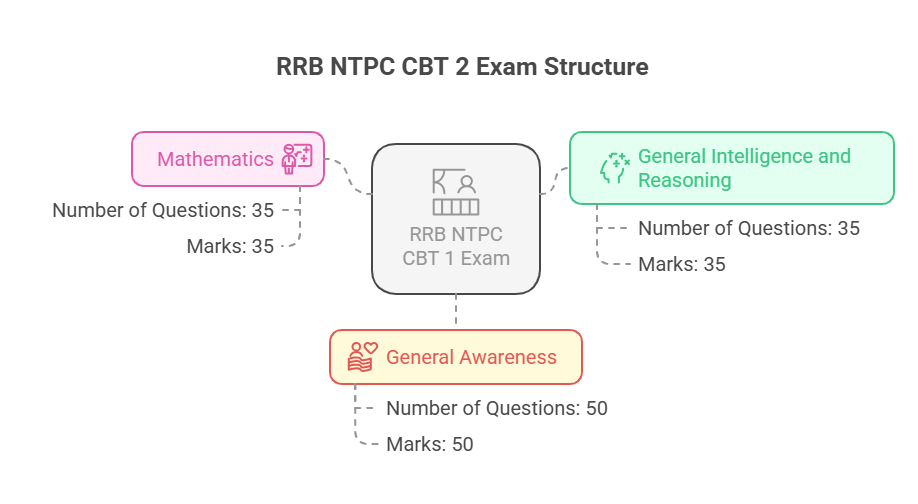
CBT 2 Exam Pattern
- Mode: Online (Computer-Based Test)
- Type of Questions: Objective Type MCQs
- Total Questions: 120
- Total Marks: 120
- Negative Marking: 1/3rd mark deducted per wrong answer
- CBT 2 marks determine the final merit list
RRB NTPC Syllabus PDF Download
For better preparation and understanding of the syllabus, we have shared the official PDF for the RRB NTPC Syllabus for both CBT 1 and CBT 2. You can download the syllabus PDF and study subject-wise and topic-wise.
Download Official RRB NTPC Syllabus PDF
Preparation Plan after Reviewing Syllabus
To crack the RRB NTPC 2026 Exam, candidates must prepare as per the updated syllabus & exam pattern, which has been discussed below. Besides this, the candidates must also focus on some important RRB NTPC Preparation Tips that are shared by the candidates who cleared their NTPC exams previously.
- Plan a preparation study plan and follow it throughout the period to make sure you cover all the topics on time.
- Select the right online classes and study material.
- Understand the exam pattern with the right approach and prepare for the subject you are weak in first.
- Attempt mock tests and previous years' papers regularly to analyse your preparation.
- Keep yourself healthy and hydrated.
| Related Links | |
| RRB NTPC Previous Year Question Papers | RRB NTPC Exam Pattern 2026 |
| RRB NTPC Salary Structure | RRB NTPC Eligibility 2026 |
| RRB NTPC Cut Off | RRB NTPC Preparation Tips |