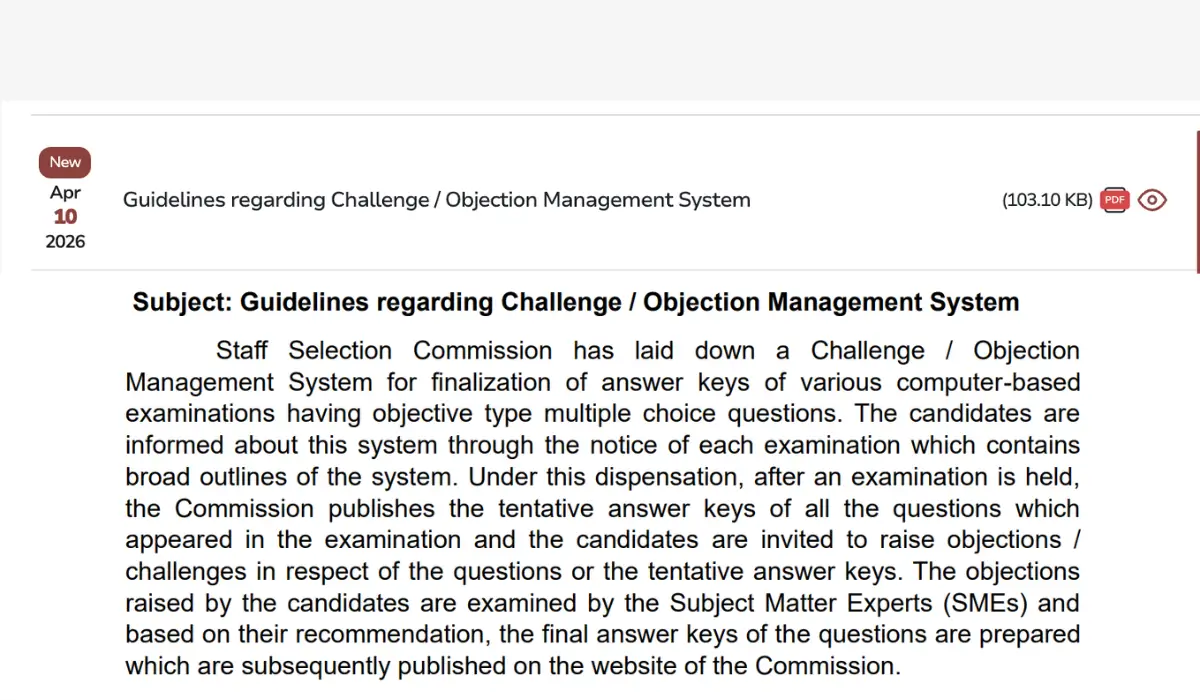
The Staff Selection Commission (SSC) has released revised guidelines for the Answer Key Challenge and Objection Management System. These rules are applicable to the SSC GD Constable 2026 exam and the SSC Computer Based Exams (CBEs), which will be conducted from this year onwards.
What is SSC Answer Key Objection System?
The Staff Selection Commission (SSC) releases a provisional answer key on www.ssc.gov.in after every SSC exam and also provides the facility to challenge or raise objections against it. Candidates are provided with a time period during which they can submit their objections with valid proof and a nominal fee.
Thereafter, the received objections are reviewed by appointed Subject Matter Experts (SMEs), and the final answer key is prepared, which is then considered for preparing the result.
SSC 2026 New Objection Rules
Staff Selection Commission (SSC) has received multiple complaints, RTIs, and even court cases regarding answer key disputes. Based on the candidates’ feedback and Legal observations (including court remarks), the commission has minutely reviewed the system and introduced clear, structured guidelines to avoid confusion and ensure fairness. SSC Answer Key Objection Rules 2026 are explained in details below for every point.
1. What Happens if a Question is Incorrect or Ambiguous?
If a question is
- Is wrongly framed
- Has unclear meaning
- Has no correct answer
Then: The question will be cancelled and full marks will be awarded to all candidates.
Note- This will not affect the merit ranking since all candidates get equal marks.
2. What if a Question Has Multiple Correct Answers?
In some cases, more than one option may be correct.
SSC Rule:
- Candidates selecting any correct option → Full marks
- Candidates selecting wrong option → Negative marking
- Candidates not attempting → Zero marks
Example: If 3 options are correct and you marked any one of them, you get full marks.
3. What if a Question is Out of the syllabus?
Although rare, if experts find a question completely out of syllabus:
Then: The question will be removed and marks will be given to all candidates
4. Rules for Language / Translation Errors
SSC exams are conducted in multiple languages. If there is an error in a specific language:
Then: The decision will be made only for that language Other language versions will be evaluated separately
Example: If a Hindi question is wrong but English is correct: Hindi candidates get benefit and English candidates are evaluated normally
5. Only Valid Objections Will Be Accepted
SSC clearly states: Only meaningful and valid objections will be considered. Minor errors (like small typos) will be ignored. Candidates should avoid unnecessary or technical objections
6. “Best Answer” Principle by Experts
Subject experts follow the most appropriate answer approach:
- The most logical and clear answer will be accepted
- Complex or forced interpretations will be rejected
This means: Do not claim multiple answers if one option is clearly correct
7. Number of Objections Does Not Matter
Many candidates think, “If more people raise objections, it will be accepted” This is NOT true.
SSC Rule:
- Even one strong objection can be accepted
- Hundreds of weak objections may be rejected
What are the Benefits of the New SSC guidelines?
These updated rules for the SSC Answer key guidelines bring multiple advantages to the current system:
- This gives more transparency in the evaluation process
- With new guidelines, candidates get to understand the fair marking system
- Understanding the new guidelines, it reduces the confusion among candidates regarding the answer key objection process.
- This leads to a faster resolution of objections and a clearer understanding of how results are calculated.



 SSC CGL Shift Timings 2026: Check Tier 1...
 SSC CPO 2026: 7 Major Changes Aspirants ...
 SSC CHSL 60 Day Study Plan 2026: Day-wis...