TNPSC Field Assistant Syllabus 2026, along with the exam pattern, is provided in this article for the TNPSC Field Assistant Exam. We have provided subject-wise topics to help candidates cover the syllabus much before the examination. The exam includes various subjects such as Tamil, General Studies, Aptitude & Mental Ability, and a Trade subject (at the ITI level). Candidates must plan a well-structured study timetable for better preparation across all subjects.
TNPSC Field Assistant Syllabus and Exam Pattern 2026
Candidates preparing for the Combined Technical Services (ITI Level) Examination for the post of Field Assistant under TNPSC Field Assistant Recruitment 2026 can refer to the subject-wise topics provided in this article to start their preparation. The TNPSC Field Assistant syllabus is designed as per the official exam pattern, helping aspirants understand exactly what to focus on more.
| TNPSC Field Assistant Syllabus and Exam Pattern 2026- Summary | |
| Conducting Body | Tamil Nadu Public Service Commission (TNPSC) |
| Post name | Field Assistant |
| Total Questions | 400 |
| Total marks | 450 |
| Duration | 3 hours each paper |
| Negative Marking | 0.25 mars |
| Selection Process | Written Exam and Document Verification |
| Official website | https://tnpsc.gov.in/ |
TNPSC Field Assistant Exam Pattern 2026
The exam pattern for TNPSC Field Assistant consists of two papers, Paper 1 and Paper 2, as mentioned below
Paper 1: Tamil, General Studies, Aptitude, and Mental Ability
Paper 1 has three sections: Tamil, GS, and Mental Ability. There will be 200 questions for 150 marks from Tamil Language, General Studies, Aptitude, and Mental Ability. The duration of the exam is 3 hours, and there is a negative marking of 0.25 marks for every wrong answer
Part A
This section focuses on the subject Tamil, and it carries a total of 100 questions.
Part B
Part B covers General Studies, which covers topics related to current affairs, geography, history, polity, and other general knowledge areas. This section consists of 75 questions.
Part C
Part C of Paper I has 25 questions and tests the candidate’s thinking ability, including logic, numbers, and problem-solving skills.
Paper 2: Trade Subject (Electrician/Wireman – ITI Level)
- There will be a second paper of 200 questions for 300 marks, based on Trade-Specific Knowledge
- The total time given to the Paper 2 is 3 hours.
- 0.25 marks will be subtracted for an incorrect attempt.
| Paper | Subjects | Questions | Marks | Duration |
|---|---|---|---|---|
| Paper I | Part A: Tamil | 100 | 150 | 3 Hours |
| Part B: General Studies | 75 | |||
| Part C: Aptitude & Mental Ability | 25 | |||
| Paper II | Trade Subject (Electrician/Wireman – ITI Level) | 200 | 300 | 3 Hours |
| Total | 400 | 450 | 6 hours | |
TNPSC Field Assistant Syllabus 2026
The Tamil Nadu Public Service Commission (TNPSC) has shared a detailed list of subject-wise topics as mentioned in the TNPSC Field Assistant Syllabus 2026. Candidates should study these topics and use them to prepare effectively for the exam, following the exam pattern provided.
Paper 1: Tamil Language, GS, Aptitude, and Mental Ability
Paper 1 includes Tamil Language, General Studies, Aptitude, and Mental Ability. The subject-wise topics related to these sections are detailed below
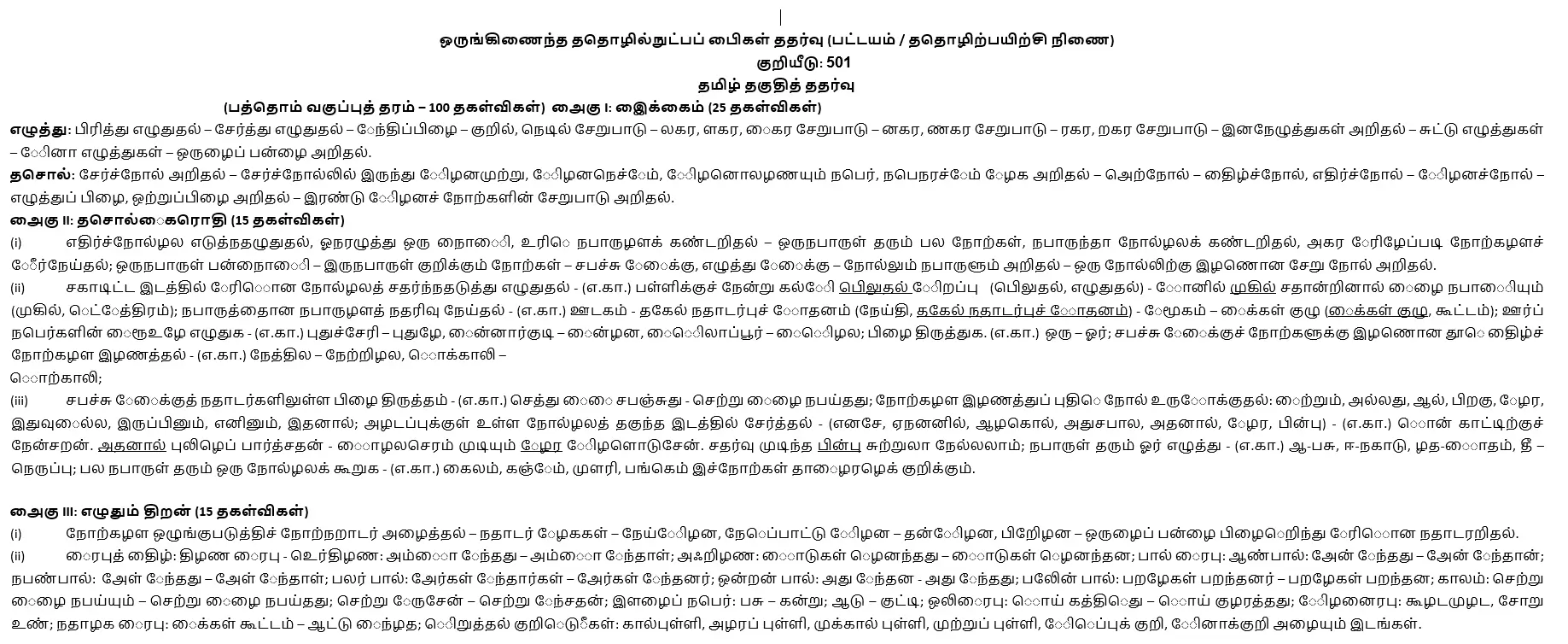
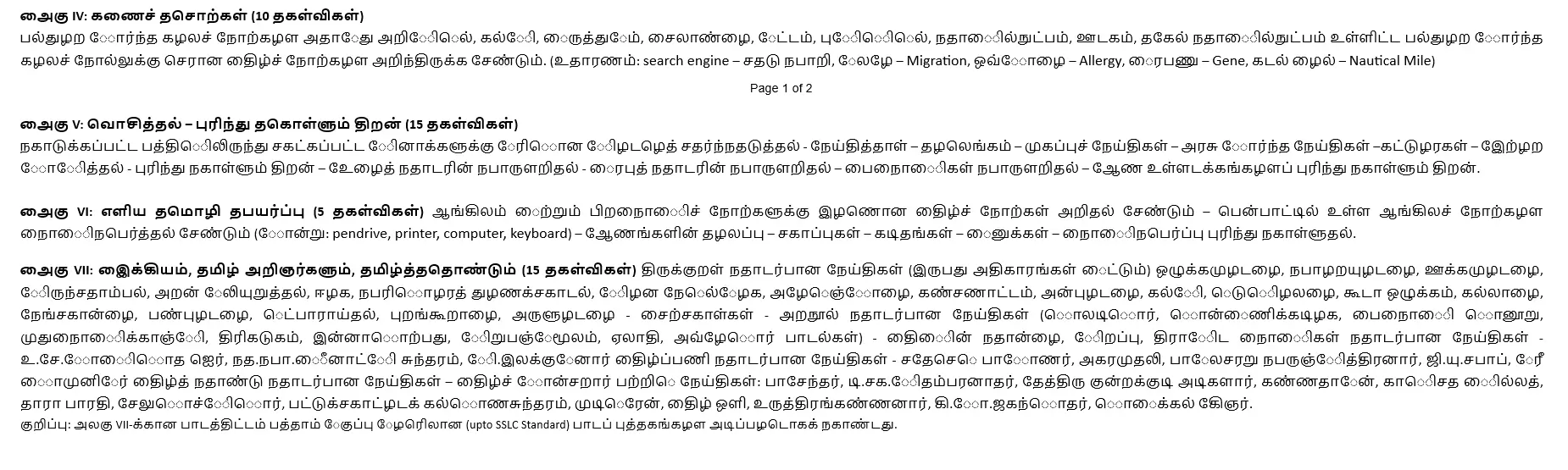
TNPSC Field Assistant Syllabus for Tamil Language (100 Questions)
General Science (5 Questions)
- Nature of the Universe
- Measurement of physical quantities
- General scientific laws in motion, force, pressure, and energy
- Everyday applications of basic principles of mechanics, electricity, magnetism, light, sound, heat, and nuclear physics
- Elements and compounds, acids, bases, salts, petroleum products, fertilizers, pesticides, metallurgy, food adulterants
- Life science: Classification of living organisms, evolution, genetics, physiology, nutrition, health and hygiene, human diseases
- Environmental science
- Latest inventions in science and technology
- Current affairs
Geography (5 Questions)
- Earth’s location and physical features
- Monsoon, rainfall, weather, and climate
- Water resources – Rivers
- Soil, minerals, and natural resources
- Forest and wildlife
- Agricultural patterns
- Transport and communication
- Population density and distribution in Tamil Nadu and India
- Natural calamities and disaster management
- Environment and climate change
- Geographical landmarks
- Current affairs
History & National Movement (10 Questions)
- South Indian history
- National Renaissance and early uprisings against British rule
- Indus Valley Civilization
- Guptas, Delhi Sultans, Mughals, and Marathas
- Indian National Congress and emergence of leaders: B.R. Ambedkar, Bhagat Singh, Bharathiar, V.O. Chidambaranar, Thanthai Periyar, Jawaharlal Nehru, Rabindranath Tagore, Kamarajar, Mahatma Gandhi, Maulana Abul Kalam Azad, Rajaji, Subhash Chandra Bose, Muthulakshmi Ammaiyar, Muvalur Ramamirtham
- Tamil Nadu’s contribution and modes of agitation
- Characteristics of Indian Culture, Unity in Diversity: Race, Language, Customs
- India as a secular state
Indian Polity (15 Questions)
- Elections and Judiciary in India
- Rule of Law
- Corruption in public life and anti-corruption measures: Lokpal, Lokayukta
- Right to Information
- Empowerment of Women
- Consumer Protection Forums
- Human Rights Charter
- Constitution of India – Preamble and salient features
- Union, State, and Union Territory
- Citizenship, Fundamental Rights, Fundamental Duties, Directive Principles of State Policy
- Union Executive and Legislature; State Executive and Legislature
- Local Governments and Panchayat Raj
- Federalism and Centre-State relations
- Political parties and political systems in Tamil Nadu and India
- Current affairs
Indian Economy & Tamil Nadu Development (20 Questions)
- Application of Science and Technology in agriculture
- Industrial growth and rural welfare programmes
- Social issues: Population, education, health, employment, poverty
- Social justice and social harmony in socio-economic development
- Education and health systems in Tamil Nadu
- Impact of Tamil Nadu’s geography on economic growth
- Nature of Indian economy
- Five-Year Plans – Models and assessment
- Planning Commission and NITI Aayog
- Sources of revenue – RBI, Finance Commission
- Resource sharing between Union and States
- GST (Goods and Services Tax)
- Economic trends – Employment generation, land reforms, agriculture
- Government welfare schemes
- Current socio-economic issues
- Current affairs
History, Culture & Movements of Tamil Nadu (20 Questions)
- Relevance to socio-political and economic affairs
- Philosophical insights
- Tamil Nadu’s role in the freedom struggle
- Early agitations against British rule
- Role of women in the freedom movement
- Social reformers and reform movements
- History of Tamil society and archaeological discoveries
- Tamil literature: Sangam age to contemporary times
- Thirukkural
- Secular significance
- Relevance to daily life
- Impact on humanity
- Universal values
- Social transformation in Tamil Nadu
Aptitude (15 Questions)
- Ratio and Proportion
- Simple Interest
- Compound Interest
- Area and Volume
- Time and Work
- Simplification
- Percentage
- Highest Common Factor (HCF)
- Lowest Common Multiple (LCM)
Reasoning (10 Questions)
- Visual reasoning
- Alphanumeric reasoning
- Number series
- Logical reasoning
- Puzzles
- Dice
Paper II – Trade: Electrician and Wireman (ITI Standard)
Unit I: Safety Rules & Handling Tools (10 Questions)
- Safety Rules and Safety Signs
- Electrical Hazards and Prevention
- Rescue Operation and First Aid
- Personal Protective Equipment (PPE)
- Safe Handling of Tools and Materials
- Care and Maintenance of Tools
- Types of Fire and Fire Extinguishers – Types and Working Principles
Unit II: Fundamentals of Electrical & Electronics (20 Questions)
- Alternating Current (AC) Circuits:
- R-L, R-C, and R-L-C Circuits
- Inductive and Capacitive Reactance
- Direct Current (DC) and AC Systems – Advantages
- Related Terms: Active and Reactive Power
- Fundamentals of Electricity Terms and Definitions
- Effects of Electricity – Fundamental Laws
- Ohm’s Law, Kirchhoff’s Laws, Laws of Resistance
- Series and Parallel Circuits
- Single-phase and Three-phase Systems
- Star and Delta Connections
- Balanced and Unbalanced Loads
- Basic Electronics:
- Active and Passive Components
- Rectifiers
- Transistors, Characteristics and Applications
Unit III: Electrical Machines (15 Questions)
- Care and Maintenance
- AC Machines
- Alternators: Working Principle, Construction, Types, Characteristics
- Parallel Operation, Care and Maintenance
- DC Machines
- DC Generators: Working Principle, Construction, Types
- Armature Reaction and Commutation
- Applications
- DC Motors: Principle, Starting Methods, Speed Control, Applications
- Three-Phase Motors: Working Principle, Types, Characteristics, Starters
- Single-Phase Motors: Starting Methods, Applications, Maintenance
Unit IV: Transformers (20 Questions)
- Working Principle and Classifications
- Parallel Operation, Voltage Regulation, Efficiency, and Losses
- Cooling Methods, Protective Devices
- Materials Used (Core and Winding)
- EMF Equation, Construction, Transformation Ratio
- Single-phase and Three-phase Transformers Types
- Transformer Testing Open Circuit (OC), Short Circuit (SC), Oil Test
- Care and Maintenance, Transformer Earthing
Unit V: Measuring Instruments, Lighting (20 Questions)
- Wattmeter, Megger, Earth Tester – Working and Applications
- Illumination:
- Basic Terms and Laws
- Types of Lamps – Construction and Details
- Classification – Operating Forces
- Ammeter, Voltmeter, Multimeter
- Power Factor Meter, Tong Tester, Frequency Meter, Energy Meter
- Lighting Systems – Types and Applications
Unit VI: Power Generation (20 Questions)
- Thermal, Nuclear, and Hydel Power Plants
- Solar and Wind Energy
- Conventional & Non-Conventional Sources of Energy
- Power Generation Systems – Working Principles
- Solar Cells and Panels – Types and Connections
Unit VII: Transmission & Distribution (30 Questions)
- Busbars, Circuit Breakers, Isolators, Control Panels
- Protection Relays, Schemes, Substation Earthing
- Construction Standards for Lines and Equipment
- Indian Electricity (IE) Rules Related to Transmission and Distribution
- Transmission Lines – LV, MV, HV
- Poles, Conductors, Insulators – Types and Materials
- Sag, Corona, Skin Effect, Line Losses
- Advantages of AC Transmission Over DC
- Substations, Types and Equipments:
- Substation and Line Maintenance
Unit VIII: Cells and Batteries (15 Questions)
- Construction, Charging Methods, Testing
- Care and Maintenance
- Applications, Advantages, and Disadvantages
- Chemical Effects of Electric Current
- Laws of Electrolysis
- Types of Cells – Series and Parallel Grouping
- Lead Acid Batteries:
Unit IX: Control Panels & Wiring Systems (25 Questions)
- EMI/EMC Considerations
- Testing of Control Circuits
- Circuit Breakers: MCB, MCCB, ELCB, RCCB, GFCI
- Control Panels: Components and Symbols
- Relays, Contactors, Control Cables
- Domestic Wiring:
- Types (Conduit, Casing-Capping, Surface, etc.)
- Smart Home Wiring – Automation Basics
- IE Rules and National Building Codes
- Voltage Drop Concept – Power & Lighting Circuits
- Pre-service Testing, Estimation (Domestic, Commercial, Industrial)
- Earthing: Importance, IE Rules, Testing and Improving Earth Resistance
Unit X: Underground Cables, Conductors, Insulators (25 Questions)
- Joints, Terminations, and Laying Standards
- Cable Testing and Fault Location
- Pillar Box & Types
- Ring Main Unit (RMU)
- Conductors and Insulators:
- Properties of Conductors and Insulation
- Advantages of Stranded Conductors
- Underground (UG) Cables:
- Construction and Parts
- Advantages and Disadvantages
- Types of UG Cables
- Cable Insulation and Voltage Grading
- Types of Insulators Dielectric Strength, Voltage Grade
- Current Rating
TNPSC Field Assistant Syllabus 2026 PDF
The official PDF for the posts of Field Assistant is shared in the table below. Candidates can download the TNPSC Field Assistant Syllabus 2026 PDF for Tamil, GS, Aptitude and Trade subjects and print it for reference during their preparation.
| Subjects | |
| Tamil | Download PDF |
| GS and Aplitude Mental Ability | Download PDF |
| Trade Subject | Download PDF |



 Bihar Librarian Syllabus 2026, Exam Patt...
 MP Police Constable Syllabus 2026, Exam ...
 UPESSC Assistant Professor Syllabus 2026...