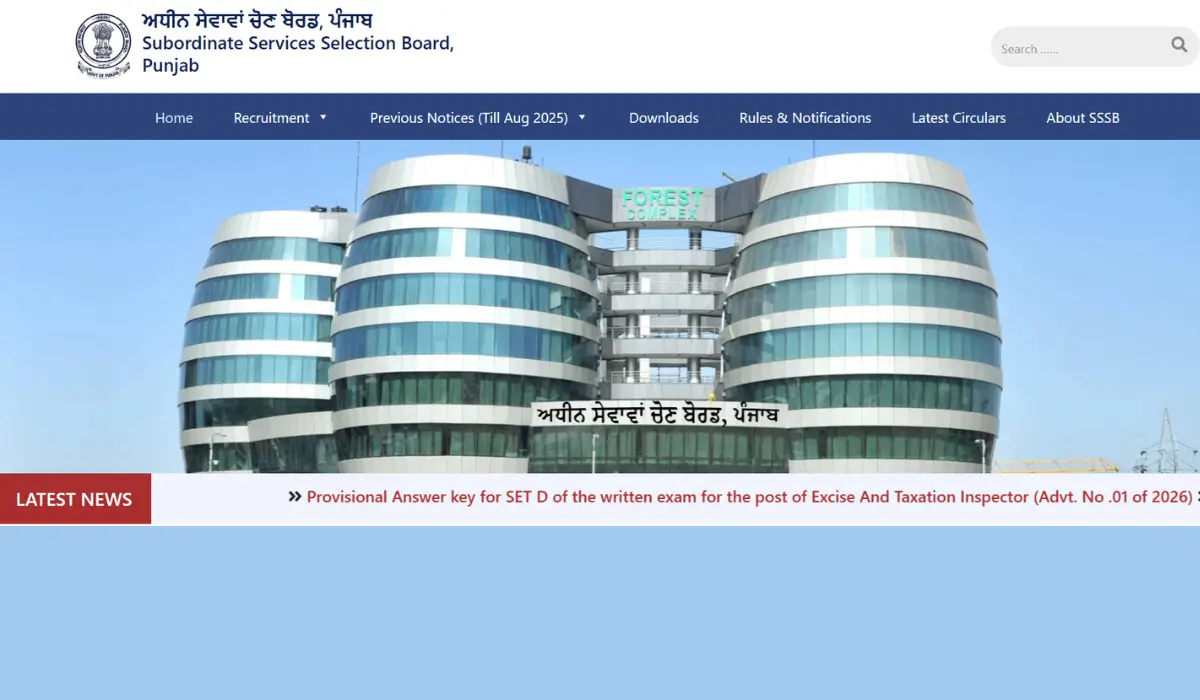
PSSSB Excise Inspector Answer Key 2026 has been released at https://sssb.punjab.gov.in/ for the PSSSB Excise Inspector written exam 2026 (Advt. No. 01/2026) held on 31st May 2026. With the help of the answer key, candidates can evaluate their performance in the exam. Candidates who find any incorrect answer can raise objection from 3rd to 5th June 2026 (5 pm).
PSSSB Excise Inspector Answer Key 2026 Out
The Answer Key for PSSSB Excise Constable Exam is important for candidates to know how well they have performed in the examination and their qualifying status for the next phase before the announcement of the results. Along with the answer key, candidates are provided an opportunity to raise objections in the exam.
| Punjab Excise Inspector Answer Key 2026- Overview | |
| Organization Name | Punjab Subordinate Service Selection Board (PSSSB) |
| Advt. No. | 01/2026 |
| Post Name | PSSSB Excise and Taxation Inspector |
| Vacancies | 197 |
| Answer Key Release Date | 1st June 2026 |
| Raise Objection Dates | 3rd to 5th June 2026 (5 pm) |
| Exam Date | 31st May 2026 |
| Mode of Exam | Online |
| Total Marks | 50 (Part A), 100(Part B) |
| Total Questions | 50 (Part A), 100(Part B) |
| Exam Duration | 02 Hours 30 Minutes |
| Marking Scheme | Each question carries 1 mark |
| Negative Marking | 1/4th mark for each incorrect answer in Part B |
| Official Website | https://sssb.punjab.gov.in/ |
PSSSB Excise Inspector Answer Key 2026 PDF
The answer booklet for the PSSSB Excise Inspector is released separately for all the sets (A, B, C, D). The direct set-wise Answer Key PDF download links are provided below. Download for your respective set and check the correct answer to all questions asked in the exam.
| SET | Answer Key PDF |
| Set A | Click to Download |
| Set B | Click to Download |
| Set C | Click to Download |
| Set D | Click to Download |
Steps to Check PSSSB Excise Inspector Answer Key 2026
- Go to the official website of Punjab Subordinate Service Selection Board (PSSSB): https://sssb.punjab.gov.in/.
- Navigate to “Answer Keys” under Online Applications/Advertisements.
- Click on the “Provisional Answer key for SET A, B, C, D of the written exam for the post of Excise And Taxation Inspector (Advt. No .01 of 2026)” link.
- Select your exam set (A / B / C / D) and download the corresponding PDF.
- Cross-check your answers and calculate your marks using the marking scheme.
Punjab Excise Inspector Answer Key 2026- Raise objection Process
Along with the provisional answer key, the Punjab Subordinate Service Selection Board (PSSSB) is also providing an opportunity to raise objections to the answer key from 3rd to 5th June 2026 (5 pm). The objection should be sent via Google Form https://forms.gle/AGFAmBDKuz6PtfXRA along with necessary documentary proof (if any).
Candidates can also challenge the provisional answer key by following the steps mentioned below-
- Download the official Objection/Grievance Form from the PSSSB website https://sssb.punjab.gov.in/.
- Fill in the form clearly, showing the Question Number, your claimed correct answer, and the reason for objection.
- Attach valid documentary proof (textbook reference, official publication, etc.) in support of your objection.
- Send scanned copies of the Grievance Form, supporting documents, and the DD, and send via Google Form https://forms.gle/AGFAmBDKuz6PtfXRA along with necessary documentary proof (if any).
Details To be Checked in PSSSB Excise Inspector Response Sheet PDF
The answer key for the PSSSB Excise Inspector written examination includes all the correct answer of questions asked in the exam.
- Name of the examination
- Post Name (Excise and Taxation Inspector)
- Exam date
- Question booklet series (A, B, C or D)
- Question numbers
- Section-wise answer for Part A and Part B
- Official answers for each question
PSSSB Excise Inspector Question Paper 2026 PDF
The question paper PDF for the PSSSB Excise Inspector Exam 2026 has been provided below. The question paper gives you a realistic insight into the exam pattern, type of questions asked, and the difficulty level of the exam.
What is PSSSB Excise Inspector Marking Scheme?
PSSSB Excise Constable Exam includes 2 parts. Part A is qualifying in nature, and Part B will be held for a total of 100 marks. Each question carries 1 mark. There will be no negative marking in Part A, and there will be a negative marking of 1/4th mark for each incorrect answer in Part B.
- Correct Answer: +1 Mark
- Incorrect Answer: -1/4th Mark (Part B only)
How to Calculate Your PSSSB Excise Inspector Score?
Using the formula below, candidates can estimate their marks after checking the answer key:
- Score = (Number of Correct Answers × 1) – (Number of Wrong Answers × 0.25 (for Part 2)))
- Example: If you attempted 100 questions, got 80 correct and 15 wrong
- Score = (80 × 1) – (15 × 0.25) = 80 – 3.75 = 76.25
PSSSB Excise Inspector Exam Structure
The exam was conducted in offline mode, and the structure of the question paper is as follows.
- Type of Questions: Objective-type multiple-choice questions
- Total Marks: 50 (Part A), 100(Part B)
- Total Questions: 50 (Part A), 100(Part B)
- Exam Duration: 02 Hours 30 Minutes
- Topics: Punjabi (Qualifying Nature), General Knowledge and Current affairs of National and International importance, Punjab History and Culture, Logical Reasoning & Mental Ability, Punjabi, English, and ICT.



 SSC CGL Question Paper 2026 Out, Downloa...
 PSSSB Clerk Question Paper 2026 Out (11 ...
 OSSTET Question Paper 2026 Out (30 Sept)...