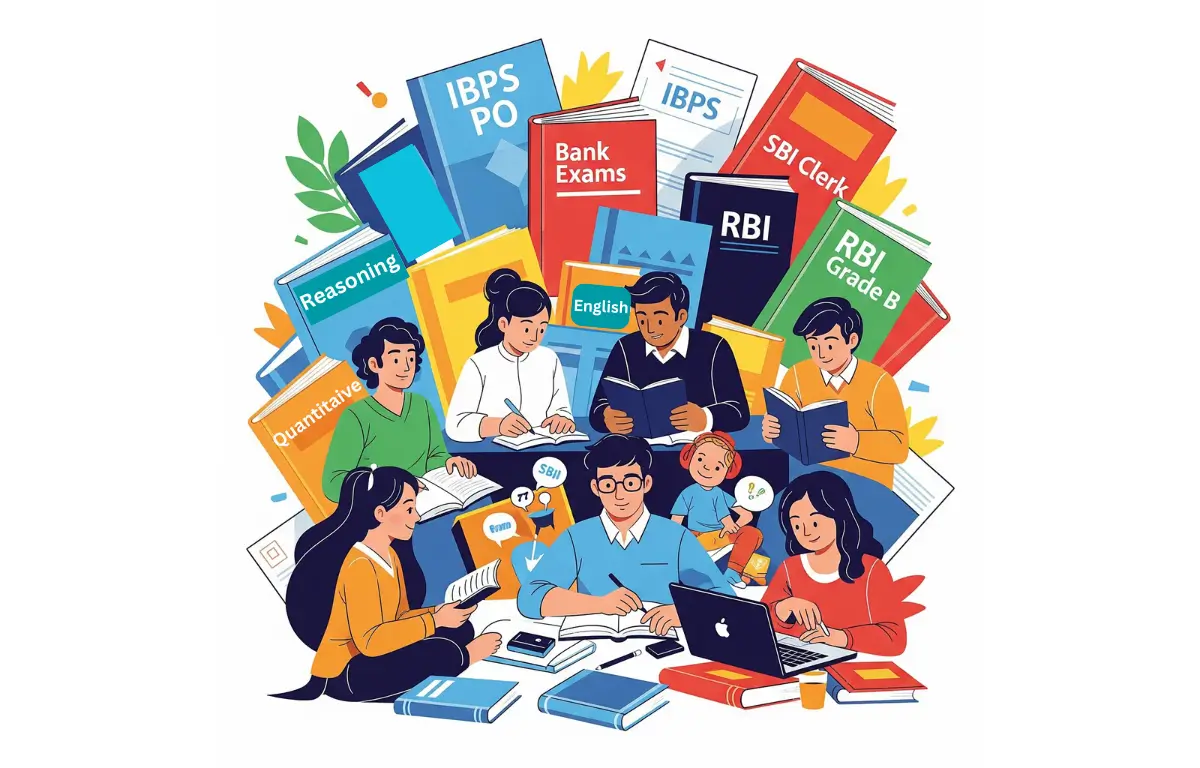
Every year, lakhs of graduates compete for a limited number of seats in SBI, IBPS, and RBI recruitment drives. The 2026–27 cycle has brought real changes — higher vacancies in some exams, a revised IBPS PO Mains pattern, and a new personality test stage — so a preparation strategy based only on last year’s pattern will not be enough. This guide walks through what’s changed, the current exam calendar, subject-wise syllabus, and a practical study plan for the exams still ahead in 2026.
How to Prepare for Bank Exams in 2026?
It’s important to build a solid foundation in the basic concepts, as advanced questions can be overwhelming without a clear understanding of the fundamentals. You can also refer to study materials for bank exams to gain insights into the exam pattern and difficulty level. In this article, we will guide you through the process of preparing for bank exams and securing a job in the banking industry.
What’s New in Bank Exam Preparation for 2026?
Some structural changes are more important than general tips this year, and candidates preparing from older strategy articles will miss them:
| Changes | Exam Name | Details |
| Revised Mains Pattern | IBPS PO | The objective paper expanded from 145 to 170 questions (200 marks); general/economy/banking awareness now includes digital & financial awareness and RBI circulars |
| New Selection Stage | IBPS PO | A non-qualifying but mandatory Personality Test has been added between Mains and Interview |
| Merit Weightage Changed | IBPS PO | Final merit still 80% Mains + 20% Interview; Prelims remains qualifying only |
| Mains structure changed | IBPS Clerk | In the Clerk mains exam, candidates must solve 160 questions in 125 minutes. |
Start with a clear plan for bank exam preparation.
The first step in preparing for any bank exam is to understand the subjects. Make study notes of all the important topics of Quantitative Aptitude, Reasoning, English, and General Awareness subjects. This will help you allocate time effectively to each topic and monitor your progress.
For Quantitative and Reasoning sections:
- These are critical in deciding your final score.
- These areas demand regular practice and a calm mindset to solve problems quickly and accurately. Start by identifying your strengths and weaknesses.
- Focus more on areas that need improvement, and use previous years’ papers to understand recurring question patterns.
- Make it a habit to solve 50-100 questions daily and take mock tests regularly to build confidence and fine-tune time management.
- Remember, every mistake is a learning opportunity; the more you analyse and improve, the better you will become.
For the English Language
- This section can be a game-changer in bank exams. Treat it not as a subject but as a language to master step-by-step.
- Read newspapers, editorials, or online articles daily to build your reading skills and vocabulary.
- Practice speaking English with friends or family to improve fluency.
- Strengthen your grammar basics using simple guides or videos, and learn from mistakes made during mock tests.
- Progress matters more than perfection, so take small steps daily toward improvement.
For General Awareness (GA)
- GA is particularly important for the mains exam. It covers topics like banking news, government schemes, international events, and RBI updates.
- Stay updated by reading current affairs daily from reliable sources and make weekly or monthly revisions to retain information.
- Use videos or mnemonics to simplify learning and make it fun.
- Stick to one or two sources for current affairs and review them multiple times for better retention.
8-Week Study Plan for Prelims
Create a well-structured timetable and follow it every day without skipping, as clearing bank exams requires efficiency and thorough revision. Following a timetable with patience and dedication helps you cover all the topics timely.
| Weeks | Focus |
| Week 1-2 | Diagnostic mock + syllabus mapping; identify 3-4 weak topics per section |
| Week 3-5 | Topic-wise practice, weighted toward weak areas; daily 1 sectional mock |
| Week 6-7 | Full-length mocks every alternate day + detailed error analysis |
| Week 8 | Daily full mocks, revision of formulas/shortcuts, no new topics |
Understand Bank Exam Syllabus & Pattern
Aspirants preparing for banking need to know the latest Bank Exam Syllabus for SBI PO, SBI Clerk, IBPS PO, IBPS Clerk, RBI Grade B, etc. There is a common set of syllabus for bank exams that can be concluded by the observation of different bank exams and previous years’ question papers. The Bank Exam Syllabus is divided into prelims and mains exams. The syllabus for the prelims varies a little from the mains examination. The right way of preparation and the best books will help you to prepare for the banking exam and crack the exam.
Choose Best Books for Bank Exam Preparation
Choosing the “best” books for bank exam preparation depends on your current knowledge level and the specific exam you’re targeting (e.g., SBI PO, IBPS Clerk, RBI Grade B). However, below are subject-wise recommended books that consistently appear in topper lists and expert suggestions.
| Subjects | Recommended Books |
| English | “High School English Grammar & Composition” by Wren & Martin “Word Power Made Easy” by Norman Lewis “Objective English” by S.P. Bakshi |
| Quantitative Aptitude | “Quantitative Aptitude for Competitive Examinations” by R.S. Aggarwal “Fast Track Objective Arithmetic” by Rajesh Verma “Magical Book on Quicker Maths” by M. Tyra Daksh Quant By Adda247 Viral Maths By Adda247 |
| Reasoning Ability | “Logical Reasoning” by K. Kundan “A Modern Approach to Verbal & Non-Verbal Reasoning” by R.S. Aggarwal “Analytical Reasoning” by M.K. Pandey Champion’s Reasoning Book by Adda247 |
| General Awareness | “Banking Awareness” by Arihant Experts Adhyan Current Affairs Quarterly Magazine Insights of Banking Awareness By Adda247 |
| Computer | “Objective Computer Awareness” by Arihant Experts “Computer Awareness” by R. Pillai |
Practice Mock Tests Regularly to Enhance Speed & Accuracy
The time duration of the bank exam is either 1 hour or 1.5 hours, which is quite less time to solve 100 to 150 questions from 3 to 4 subjects. Therefore, besides clearing the concepts, the candidates must also focus on their speed of solving the questions, which can eventually be done by practising as many mock tests as you can. Mock tests simulate the real exam and are the backbone of your preparation. These help to build speed, accuracy, and time management skills.
After each mock test, analyse your performance to identify areas of improvement. If you struggle with time, look for ways to improve your speed. Set small goals for each mock test, focusing on strengthening your weak areas. Don’t get discouraged by low scores—every test brings you closer to success.
Add Previous Year Papers to your Preparations
To be familiar with the pattern of questions, important topics asked, and frequently asked questions, banking aspirants must add on the previous year’s question papers to their preparation. As the banking exams are conducted online so we have compiled the questions by connecting with the candidates and prepared memory-based papers for all exams, which can be accessed from the links below.
Join Online/Offline Coaching Classes for Bank Exams
Clearing bank exams requires dedicated preparation and a strategic approach. With lakhs of candidates appearing for bank exams every year, it is quite important to join the best Coaching Classes for Structured Guidance from expert faculty, to understand the concepts in an easier way, and especially for solving doubts. You can join Careerpower Offline Classes in your city to study with highly qualified teachers for all subjects who are dedicatedly indulged in helping the candidates do their best in the exams.
Conclusion
Success in bank exams requires not just hard work but also smart work. Start by ensuring that you have a strong grasp of the basics. Practise consistently and track your progress with mock tests. Stay positive; remember that setbacks can help you improve. Believe in yourself, celebrate small achievements, and keep pushing forward. Each step brings you closer to your dream job.
With the preparation, also have a regular check of the Latest Bank Exam notifications and vacancies. You can also follow Career Power Latest Bank Job Updates to stay updated and track the Upcoming Bank Exams which are to be held this year. Bank exam preparation can be challenging and time-consuming, but staying motivated is key. Break your goals into small daily targets and reward yourself for achieving them.





 SBI PO Preparation Tips 2026: The Comple...
 SSC CGL Preparation Tips 2026: Complete ...
 SSC GD Preparation Tips 2026: Complete S...