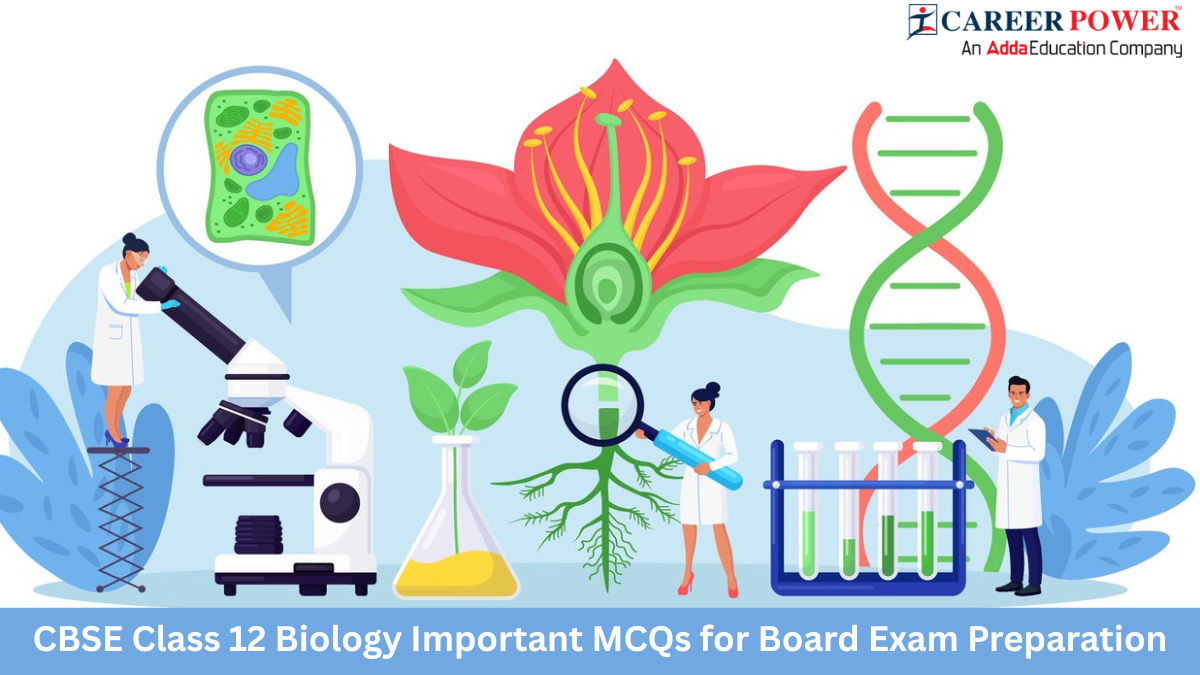
CBSE Class 12th Students appearing for the Board exams must study smartly in order to cover the entire syllabus. To help students score better we have covered CBSE Class 12th Most Important questions. These questions focus are based on the high weightage topics such as genetics, molecular basis of inheritance, biotechnology, human disease, ecology and more. Practicing these important MCQs will help you clear your concepts, build confidence to attempt the biology paper and score high marks.

CBSE Class 12 Biology Important Question PDF
CBSE Class 12 Biology Important have been provided for the students in PDF format which serves as a helpful resource to do quick revision. This PDF covers the most important questions based on the CBSE board syllabus. Students must download the PDF by clicking on the link attached below.
| CBSE Class 12 Biology MCQs PDF |
| CBSE Class 12th Biology MCQs Download PDF |
CBSE 12th Biology Chapter-wise Weightage and Most Asked Topics
Understanding the class 12th weightage including chapter name, average weightage marks and primary focus of questions helps the CBSE class 12th to focus on high scoring areas. The table given below covers questions based on CBSE latest syllabus and exam pattern to help the students plan smartly and score high in Class 12th biology exam.
| CBSE Class 12 Biology Chapter-wise Weightage and Important Topics | ||
| Chapter Name | Average Weightage (Marks) | Primary Focus of Questions / Most Asked Topics |
| Sexual Reproduction in Flowering Plants | 5 – 6 | Outbreeding devices, double fertilization, development of endosperm/embryo, and special modes like apomixis and polyembryony. |
| Human Reproduction | 6 – 7 | Spermatogenesis, oogenesis, the menstrual cycle (hormonal control), and the neuroendocrine mechanism of parturition. |
| Reproductive Health | 4 – 5 | Contraceptive methods (IUDs, pills), MTP regulations, amniocentesis, and Assisted Reproductive Technologies (IVF, GIFT, ZIFT). |
| Principles of Inheritance and Variation | 7 – 8 | Mendelian inheritance deviations (codominance, incomplete dominance), blood grouping, linkage/recombination, and chromosomal disorders like Down’s and Turner’s syndromes. |
| Molecular Basis of Inheritance | 8 – 10 | DNA structure/packaging, replication fork, transcription units, lac operon regulation, translation process, and DNA fingerprinting. |
| Evolution | 5 – 6 | Evidences for evolution (paleontology, comparative anatomy), industrial melanism, Hardy-Weinberg principle, and human evolution stages. |
| Human Health and Diseases | 7 – 8 | Life cycle of Plasmodium, pathogens (typhoid, pneumonia), immunity (active/passive, vaccines), AIDS/HIV mechanism, and drug abuse. |
| Microbes in Human Welfare | 4 – 5 | Microbes in industrial production (organic acids/enzymes), sewage treatment (STP stages), biogas production, and bio-fertilizers. |
| Biotechnology: Principles and Processes | 6 – 7 | Tools of recombinant DNA technology (restriction enzymes, vectors), PCR steps, and gel electrophoresis. |
| Biotechnology and its Applications | 5 – 6 | Bt crops (pest resistance), genetically engineered human insulin, transgenic animals, and biosafety/ethical issues. |
| Organisms and Populations | 3 – 4 | Population attributes, growth models (exponential and logistic growth curves), and population interactions (mutualism, predation, parasitism). |
| Ecosystem | 3 – 4 | Decomposition process/factors, energy flow (10% law), and ecological pyramids (number, biomass, energy). |
| Biodiversity and its Conservation | 3 – 4 | Patterns of biodiversity, species-area relationships, causes of biodiversity loss, and conservation strategies (hotspots, sacred groves). |
Top 15 Most Asked Biology MCQs from Previous Year Papers
1. The histone core in a nucleosome of chromatin thread is a/an :
(A) pentamer
(B) hexamer
(C) heptomer
(D) octamer
2. During the initial days of lactation is rich in antibody :
(A) IgE
(B) IgD
(C) IgA
(D) IgG
3. The process of splicing in eukaryotes represents the dominance of the :
(A) DNA world
(B) RNA world
(C) Protein world
(D) Lipid world
4. Regulation of lac operon by repressor is referred to as :
(A) Inducible regulation
(B) Repressible regulation
(C) Negative regulation
(D) Positive regulation
5. The pyramid of biomass in sea is generally inverted because in sea :
(A) Biomass of fishes exceeds that of phytoplankton.
(B) Number of phytoplanktons is more.
(C) Number of phytoplanktons is less.
(D) Large fishes feed on small fishes.
6. If a natural population with 50 individuals is in Hardy-Weinberg equilibrium for a gene with two alleles A and a, with the gene frequency of allele A of 0·6, the genotype frequency of Aa will be :
(A) 0·16
(B) 0·36
(C) 0·24
(D) 0·48
7. A DNA fragment has 2000 nucleotides, out of which 140 are Adenine. How many bases does this DNA segment possess that have triple hydrogen bonds between them ?
(A) 280
(B) 860
(C) 1720
(D) 1860
8. Match the items in Column I with those in Column II and select the correctly matched option :
| Column I (Cross) | Column II (Phenotypic Ratio) |
| 1. Mendelian monohybrid | (i) 1 : 2 : 1 ($F_2$) |
| 2. Mendelian dihybrid | (ii) 1 : 1 |
| 3. Incomplete dominance | (iii) 3 : 1 ($F_2$) |
| 4. Test cross (monohybrid) | (iv) 9 : 3 : 3 : 1 ($F_2$) |
Options :
(A) 1-(ii), 2-(iv), 3-(i), 4-(iii)
(B) 1-(iii), 2-(i), 3-(iv), 4-(ii)
(C) 1-(iii), 2-(iv), 3-(i), 4-(ii)
(D) 1-(ii), 2-(i), 3-(iv), 4-(iii)
9. Select the option where the contraceptive method is correctly matched with its mode of action :
| Contraceptive Method | Mode of Action |
| A. The pill | I. Prevent sperm reaching cervix |
| B. Condom | II. Prevent implantation |
| C. Vasectomy | III. Inhibits ovulation |
| D. Copper-T | IV. Semen contains no sperm |
Options :
(A) A – III, B – II, C – I, D – IV
(B) A – II, B – III, C – I, D – IV
(C) A – III, B – I, C – IV, D – II
(D) A – IV, B – III, C – II, D – I
Assertion-Reason based Questions
Note: For questions 10-15, use the following codes: (A) Both Assertion (A) and Reason (R) are true and Reason (R) is the correct explanation of the Assertion (A). (B) Both Assertion (A) and Reason (R) are true, but Reason (R) is not the correct explanation of the Assertion (A). (C) Assertion (A) is true, but Reason (R) is false. (D) Assertion (A) is false, but Reason (R) is true
10. Assertion (A): To generate only a part of the plant from a cell is totipotency.
Reason (R): Suitable special nutrient media and sterile conditions are required in ‘in vitro’ conditions for the division of cells in explants
11. Assertion (A): Biogas plants are more often built in rural areas.
Reason (R): The excreta or gobar of cattle is rich in Methanobacterium
12. Assertion (A): Linked genes do not show dihybrid F2 ratio 9 : 3 : 3 : 1.
Reason (R): Linked genes do not undergo independent assortment.
13. Assertion (A): Cu-T, Cu-7 and LNG-20 are the most widely used copper-releasing IUDs.
Reason (R): Cu-ions in IUDs effectively suppress sperm motility and the fertilising capacity of sperms.
14. Assertion (A): Indian Government has set up an organisation known as GEAC to decide the validity of GM research.
Reason (R): Genetic modification of organisms has no effect when such organisms are introduced in the ecosystem.
15. Assertion (A): RNA is unstable and can mutate at a faster rate.
Reason (R): The presence of 2′ – OH group in every nucleotide of RNA makes it labile and easily degradable.
How to Score Full Marks in CBSE Class 12th Biology
- Understand the complete CBSE Class 12 Biology syllabus and latest exam pattern before starting preparation.
- In MCQs and assertion-reason questions, read carefully and eliminate wrong options before selecting the correct answer.
- For 1–2 mark questions, write short, keyword-based answers without unnecessary explanation.
- In 3–4 mark answers, write in clear points, underline key terms, and add small diagrams if relevant.
- For 5-mark questions, write step-wise explanations with headings, flowcharts, and labelled diagrams.
- In case-based questions, read the passage carefully and answer strictly as per NCERT concepts.
- Practice neat, well-labelled diagrams like DNA, heart, flower, nephron, and lac operon.
- Always draw diagrams with pencil, label clearly, and keep them clean and simple.
- Revise high-weightage chapters like Genetics, Molecular Basis of Inheritance, Biotechnology, and Ecology regularly.
- Manage time wisely in the exam and keep a few minutes at the end for revision






 ICSE, ISC Class 10th and 12th Result 202...
 CUET City Intimation Slip 2026: Download...
 CUET Admit Card Download Guide, Importan...