
CTET Syllabus 2026 for both Paper 1 & Paper 2, Official Syllabus PDF
- Home
- CTET Syllabus 2026
There are two papers in the CTET exam: Paper 1 and Paper 2. Paper 1 is for candidates aiming to become primary teachers (Classes 1 to 5), while Paper 2 is for those aspiring to become upper primary teachers (Classes 6 to 8). For better preparation, candidates must be aware of the latest CTET syllabus along with the exam pattern and marking scheme.
CTET Syllabus and Exam Pattern 2026
To score well in the CTET 2026 exam, scheduled for 6th September 2026, a proper preparation strategy is mandatory. Knowledge of the CTET Syllabus 2026 is the prior step for beginning the preparation journey of the candidates. This article provides complete details of the syllabus for both Papers 1 and 2 of the Central Teacher Eligibility Test (CTET).
| Parameters | Paper 1 | Paper 2 |
|---|---|---|
| Subjects | Child Development and Pedagogy Language-I Language-II Mathematics Environmental Studies | Child Development and Pedagogy Language-I Language-II Mathematics and Science / Social Studies & Social Science |
| Questions | 150 | 150 |
| Maximum Marks | 150 | 150 |
| Exam Duration | 2.5 hours | 2.5 hours |
| Type of Questions | Multiple Choice Questions | |
| Mode of Exam | Offline (OMR-Based) | |
| Marking Scheme | 1 mark for each correct answer | |
| Negative Marking | No negative marking for wrong answers | |
CTET Exam Syllabus 2026
Before checking the syllabus, all candidates need to look out for the CTET Exam Pattern, as this helps to make plans for studying, and candidates can get a clear vision of which topic they should focus on more.
- CTET will be conducted in two phases: Paper 1 for Classes 1 to 5 and Paper 2 for Classes 6 to 8.
- There will be 150 MCQs in each paper.
- There will be no negative marking for any incorrect answers.
- For Paper I, the difficulty level will be of the second stage and for Paper II, the difficulty level will be of the senior secondary stage.
- CTET Paper-1 is divided into 5 sections: Child Development and Pedagogy, Language I & II, Mathematics and Environmental Science.
- CTET Paper-2 is divided into four sections: Child Development and Pedagogy, Language I & II, Mathematics/Science, and Social Studies. Students will have the choice between Maths/Science and Social Studies.
CTET Paper 1 Syllabus 2026
The Paper I exam of CTET is an exam testing a candidate based on their Language I & II, Child Development and Pedagogy, Mathematics and Environmental Studies. Let's have a look at the CTET Syllabus 2026 for the Primary Stage (Classes I-V ):
1. Child Development and Pedagogy Syllabus
a) Child Development (Primary School Child): 15 Questions
- Concept of development and its relationship with learning
- Principles of the development of children
- Influence of Heredity & Environment
- Socialization processes: Social world & children (Teacher, Parents, Peers)
- Piaget, Kohlberg and Vygotsky: constructs and critical perspectives
- Concepts of child-centred and progressive education
- Critical perspective of the construct of Intelligence
- Multi-Dimensional Intelligence
- Language & Thought
- Gender as a social construct; gender roles, gender-bias and educational practice
- Individual differences among learners, understanding differences based on diversity of language, caste, gender, community, religion etc.
- The distinction between Assessment for learning and assessment of learning; School-Based Assessment, Continuous & Comprehensive Evaluation: perspective and practice
- Formulating appropriate questions for assessing readiness levels of learners; for enhancing learning and critical thinking in the classroom and for assessing learner achievement.
b) Concept of Inclusive education and understanding children with special needs: 5 Questions
- Addressing learners from diverse backgrounds including disadvantaged and deprived
- Addressing the needs of children with learning difficulties, ‘impairment’ etc.
- Addressing the Talented, Creative, Specially abled Learners
c) Learning and Pedagogy: 10 Questions
- How children think and learn; how and why children ‘fail’ to achieve success in school performance.
- Basic processes of teaching and learning; children’s strategies of learning; learning as a social activity; social context of learning.
- Child as a problem solver and a ‘scientific investigator’
- Alternative conceptions of learning in children, understanding children’s ‘errors’ as significant steps in the learning process.
- Cognition & Emotions
- Motivation and learning
- Factors contributing to learning - personal & environmental
2. Mathematics Syllabus (30 Questions)
a) Content: 15 Questions
- Geometry
- Shapes & Spatial Understanding
- Solids around Us
- Numbers
- Addition and Subtraction
- Multiplication
- Division
- Measurement
- Weight
- Time
- Volume
- Data Handling
- Patterns
- Money
b) Pedagogical issues: 15 Questions
Nature of Mathematics/Logical thinking; understanding children’s thinking and reasoning patterns and strategies of making meaning and learning
- Place of Mathematics in Curriculum
- Language of Mathematics
- Community Mathematics
- Valuation through formal and informal methods
- Problems of Teaching
- Error analysis and related aspects of learning and teaching
- Diagnostic and Remedial Teaching
3. Environmental Studies Syllabus (30 Questions)
a) Content: 15 Questions
I. Family and Friends:
- Relationships
- Work and Play
- Animals
- Plants
II. Food
III. Shelter
IV. Water
V. Travel
VI. Things We Make and Do
b) Pedagogical Issues: 15 Questions
- Concept and scope of EVS
- Significance of EVS, integrated EVS
- Environmental Studies & Environmental Education
- Learning Principles
- Scope & relation to Science & Social Science
- Approaches of presenting concepts
- Activities
- Experimentation/Practical Work
- Discussion
- CCE
- Teaching material/Aids
- Problems
4. Language I Syllabus (30 Questions)
a) Language Comprehension: 15 Questions
Reading unseen passages – two passages, one prose or drama and one poem, with questions on comprehension, inference, grammar and verbal ability (Prose passage may be literary, scientific, narrative or discursive)
b) Pedagogy of Language Development: 15 Questions
- Learning and acquisition
- Principles of language Teaching
- Role of listening and speaking; function of language and how children use it as a tool
- A critical perspective on the role of grammar in learning a language for communicating ideas verbally and in written form
- Challenges of teaching language in a diverse classroom; language difficulties, errors and disorders
- Language Skills
- Evaluating language comprehension and proficiency: speaking, listening, reading and writing
- Teaching-learning materials: Textbook, multi-media materials, multilingual resource of the classroom
5. Language 2 Syllabus (30 Questions)
a) Comprehension: 15 Questions
Two unseen prose passages (discursive, literary, narrative, or scientific) with questions on comprehension, grammar and verbal ability
b) Pedagogy of Language Development: 15 Questions
Note: The Pedagogy of Language Development syllabus section is same on both languages.
Language 2 will be a language other than Language 1. Candidates choose 2 languages from the available list of 20 languages. The two languages must be different — you cannot choose the same language for both Language 1 and Language 2.
CTET Paper 2 Syllabus 2026
The CTET Paper 2 Syllabus includes subject-wise topics from which questions are asked in the CTET Paper 2 exam. A clear understanding of the CTET Paper 2 Syllabus 2026 helps candidates effectively excel in the exam. Here we have provided the subject-wise syllabus.
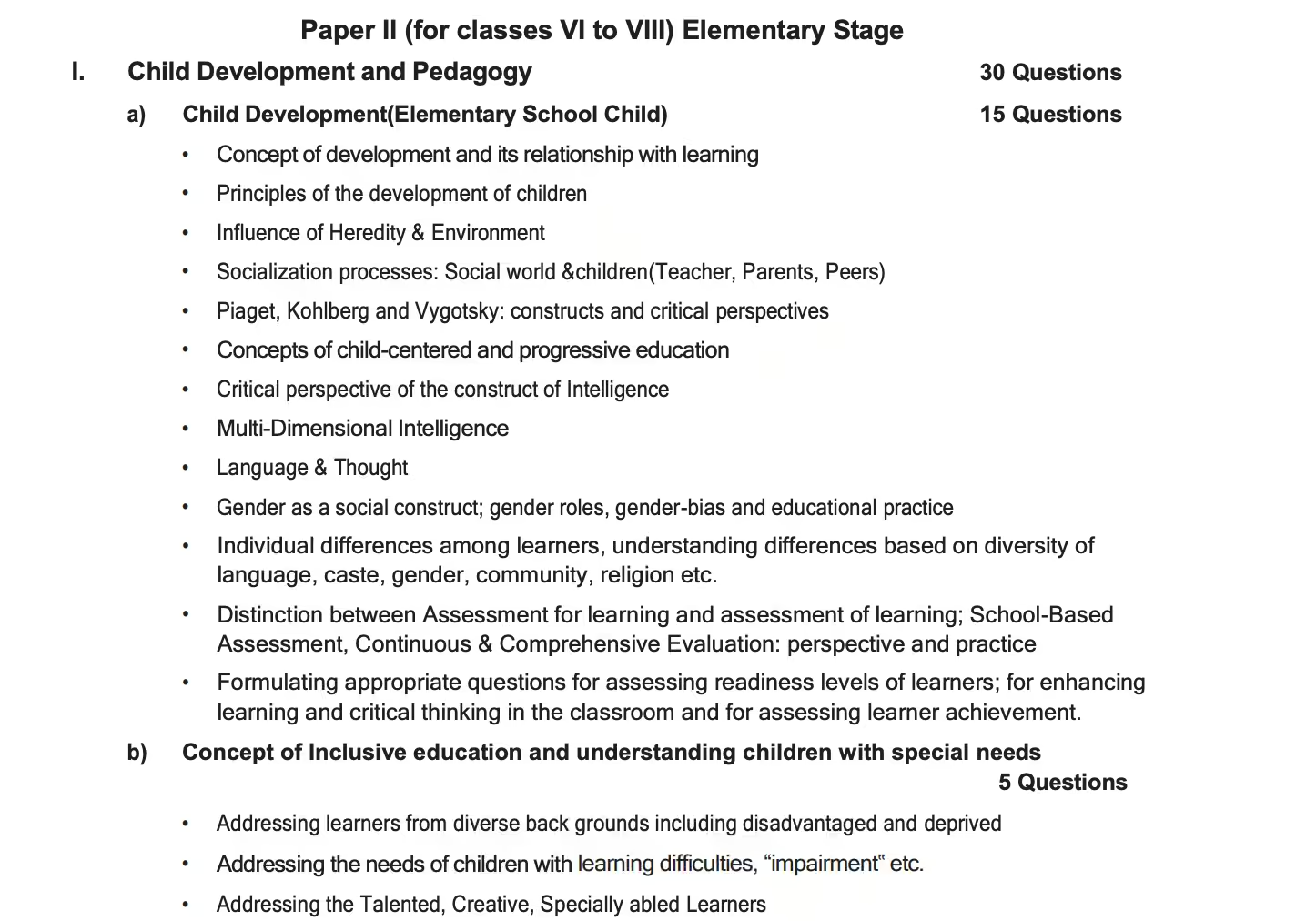
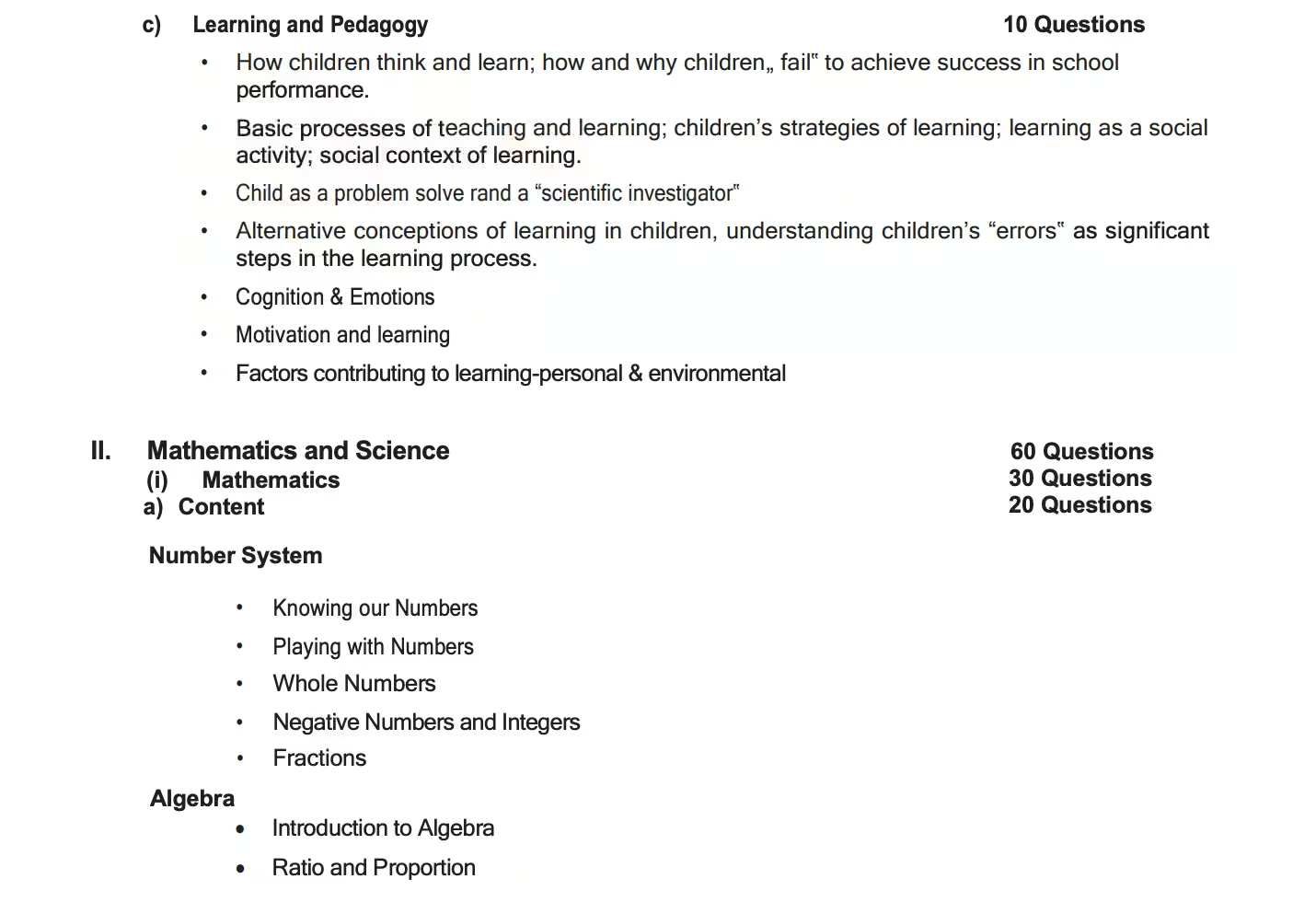
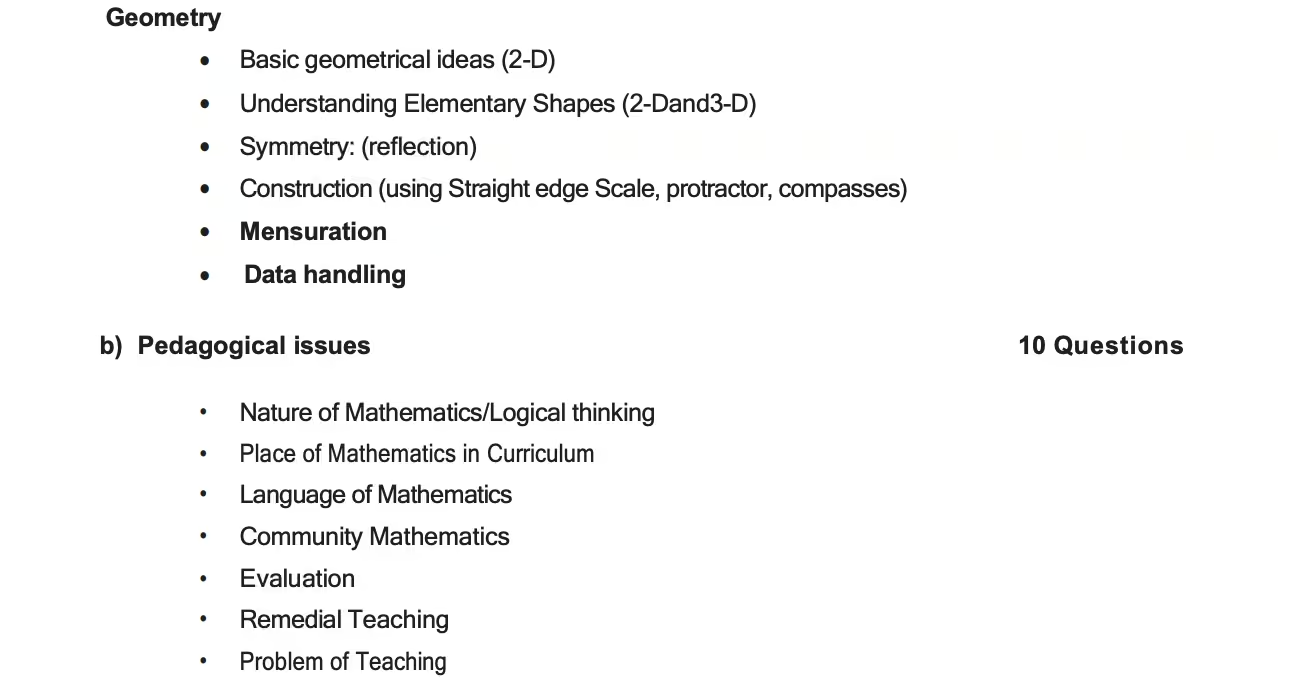
Note: In CTET Paper 2, Mathematics & Science together comprise 60 questions, while Social Studies also consists of 60 questions separately. A candidate can choose either Mathematics & Science or Social Studies.
CTET Syllabus PDF
For the candidate's ease, we have also shared the detailed CTET Syllabus PDF, which consists of all topics to be covered for the CTET 2026 Exam.
| Papers | Download PDF |
| Paper 1 | Syllabus PDF |
| Paper 2 | Syllabus PDF |
Minimum Qualifying Marks
| Category | Pass % | Passing MArks |
| General | 60% | 90/150 |
| SC/ST/OBC/PwD | 55% | 82/150 |
| Important Links | |
| CTET Eligibility 2026 | CTET Exam Pattern 2026 |
| CTET Previous Year Questions Paper | CTET Paper 2 Syllabus 2026 |
| CTET Exam Centre List | CTET Mock Test |
| CTET Admit Card 2026 | CTET Certificate 2026 |