
UGC NET Paper 1 Syllabus 2026, Download PDF in Hindi and English
- Home
- UGC NET Paper 1 Syllabus 2026
It is important to know the UGC NET Paper 1 Syllabus as it helps to have an understanding of the topics that will be covered in the UGC NET 2026 exam. Candidates who wish to take the UGC NET exam must be aware of the syllabus to know the topics asked in the exam, etc.
UGC NET Paper 1 Syllabus 2026
- UGC NET Syllabus 2026 includes 2 papers. In Paper 1, questions are asked from various topics to assess the teaching/research aptitude of the candidate, and Paper 2 includes subject-specific questions.
- UGC NET exam (Paper 1 and Paper 2) is held for a total of 3 hours without any break.
- UGC NET Paper 1 includes a total of 50 objective-type multiple-choice questions for a total of 100 marks.
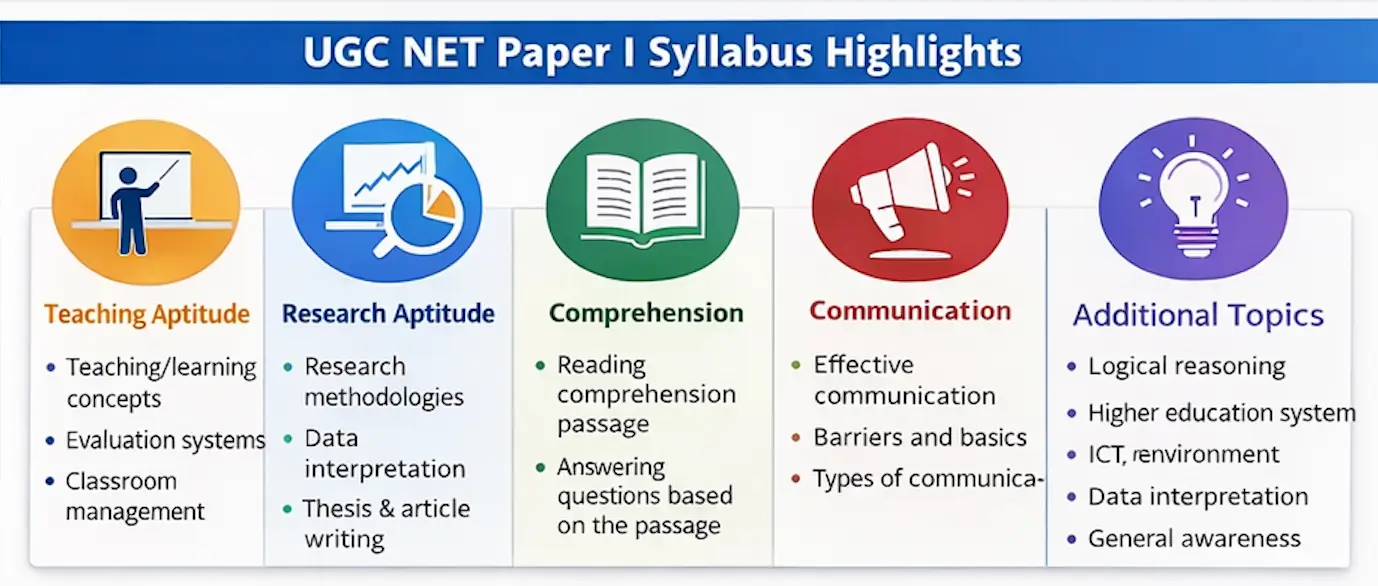
- UGC NET Paper 1 Syllabus 2026 covers a total of 10 units, which are as follows:
- Teaching Aptitude
- Research Aptitude
- Comprehension
- Communication
- Mathematical Reasoning and Aptitude
- Logical Reasoning
- Data Interpretation
- Information and Communication Technology (ICT)
- People Development and Environment
- Higher Education System
UGC NET December Notification 2026 Out - Click to Check
Unit 1: Teaching Aptitude
- Teaching: Concept, Objectives, Levels of teaching (Memory, Understanding and Reflection), Characteristics and basic requirements
- Learner’s characteristics: Characteristics of adolescent and adult learners (Academic, Social, Emotional and Cognitive), Individual differences
- Factors affecting teaching related to Teacher, Learner, Support material, Instructional facilities, Learning environment and Institution
- Methods of teaching in Institutions of higher learning: Teacher-centred vs. Learner-centred methods; offline vs. Online methods (Swayam, Swayamprabha, MOOCs etc.)
- Teaching Support System: Traditional, Modern and ICT-based
- Evaluation Systems: Elements and Types of evaluation, Evaluation in Choice Based Credit System in Higher education, Computer-based testing, Innovations in evaluation systems
Unit 2: Research Aptitude
- Research: Meaning, Types, and Characteristics, Positivism and Postpositivistic approach to research
- Methods of Research: Experimental, Descriptive, Historical, Qualitative and Quantitative Methods, Steps of Research
- Thesis and Article writing: Format and styles of referencing
- Application of ICT in research
- Research ethics
Unit 3: Comprehension
A passage of text is given. Questions are asked from the passage to be answered.
Unit 4: Communication
- Communication: Meaning, types and characteristics of communication
- Effective communication: Verbal and Non-verbal, Inter-Cultural and group communications, Classroom communication
- Barriers to effective communication
- Mass-Media and Society
Unit 5: Mathematical Reasoning and Aptitude
- Types of reasoning
- Number series, Letter series, Codes and Relationships
- Mathematical Aptitude (Fraction, Time & Distance, Ratio, Proportion and Percentage, Profit and Loss, Interest and Discounting, Averages etc.)
Unit 6: Logical Reasoning
- Understanding the structure of arguments: argument forms, the structure of categorical propositions, Mood and Figure, Formal and Informal fallacies, Uses of language, Connotations and denotations of terms, Classical square of opposition
- Evaluating and distinguishing deductive and inductive reasoning
- Analogies
- Venn diagram: Simple and multiple uses for establishing the validity of arguments
- Indian Logic: Means of knowledge
- Pramanas: Pratyaksha (Perception), Anumana (Inference), Upamana (Comparison), Shabda (Verbal testimony), Arthapatti (Implication) and Anupalabddhi (Non-apprehension)
- Structure and kinds of Anumana (inference), Vyapti (invariable relation), Hetvabhasas (fallacies of inference)
Unit 7: Data Interpretation
- Sources, acquisition and classification of Data
- Quantitative and Qualitative Data
- Graphical representation (Bar-chart, Histograms, Pie-chart, Table-chart and Line-chart) and mapping of Data
- Data Interpretation
- Data and Governance
Unit 8: Information and Communication Technology (ICT)
- ICT: General abbreviations and terminology
- Basics of the Internet, Intranet, E-mail, Audio and Video-conferencing
- Digital initiatives in higher education
- ICT and Governance
Unit 9: People, Development and Environment
- Development and environment: Millennium Development and Sustainable Development Goals
- Human and environment interaction: Anthropogenic activities and their impacts on the environment
- Environmental issues: Local, Regional and Global; Air pollution, Water pollution, Soil pollution, Noise pollution, Waste (solid, liquid, biomedical, hazardous, electronic), Climate change and its Socio-Economic and Political dimensions
- Impacts of pollutants on human health
- Natural and energy resources: Solar, Wind, Soil, Hydro, Geothermal, Biomass, Nuclear and Forests
- Natural hazards and disasters: Mitigation strategies
- Environmental Protection Act (1986), National Action Plan on Climate Change, International agreements/efforts -Montreal Protocol, Rio Summit, Convention on Biodiversity, Kyoto Protocol, Paris Agreement, International Solar Alliance
Unit 10: Higher Education System
- Institutions of higher learning and education in ancient India
- Evolution of higher learning and research in post-independence India
- Oriental, Conventional and Non-conventional Learning Programs in India
- Professional, Technical and Skill-Based education
- Value education and environmental education
- Policies, Governance, and Administration
UGC NET Paper 1 Syllabus in Hindi
Candidates can check the detailed UGC NET Paper 1 Syllabus 2025 in Hindi from here.
इकाई - 1 शिक्षण अभिवृत्ति
- शिक्षण : अवधारणाएं, उद्देश्य, शिक्षण का स्तर (स्मरण शक्ति, समझ और विचारात्मक), विशेषताएं और मूल अपेक्षाएं
- शिक्षार्थी की विशेषताएं: किशोर और वयस्क शिक्षार्थी की अपेक्षाएं (शैक्षिक, सामाजिक /भावनात्मक और संज्ञानात्मक, व्यक्तिगत भिन्नताएँ
- शिक्षण प्रभावक तत्त्व: शिक्षक, सहायक सामग्री, संस्थागत सुविधाएं, शैक्षिक वातावरण
- उच्च अधिगम संस्थाओं में शिक्षण की पद्धति: अध्यापक केंद्रित बनाम शिक्षार्थी केंद्रित पद्धति, ऑफ लाइन बनाम ऑन-लाइन पद्धतियां (स्वयं, स्वयंप्रभा, मूक्स इत्यादि)।
- शिक्षण सहायक प्रणाली : परंपरागत आधुनिक और आई सी टी आधारित।
- मूल्यांकन प्रणालियां : मूल्यांकन के तत्त्व और प्रकार, उच्च शिक्षा में विकल्प आधारित क्रेडिट प्रणाली में मूल्यांकन, कंप्यूटर आधारित परीक्षा, मूल्यांकन पद्धतियों में नवाचार।
इकाई - 2 शोध अभिवृत्ति
- शोधः अर्थ, प्रकार और विशेषताएं, प्रत्यक्षवाद एवं उत्तर-प्रत्यक्षवाद शोध के उपागम
- शोध पद्धतियां : प्रयोगात्मक, विवरणात्मक, ऐतिहासिक, गुणात्मक एवं मात्रात्मक
- शोध के चरण
- शोध प्रबन्ध एवं आलेख लेखन
- फार्मेट और संदर्भ की शैली शोध में आई सी टी का अनुप्रयोग
- शोध नैतिकता इकाई
इकाई - 3 बोध
- एक गद्यांश दिया जाएगा, उस गद्यांश से पूछे गए प्रश्नों का उत्तर देना होगा।
इकाई - 4 संप्रेषण संप्रेषण
- संप्रेषण का अर्थ, प्रकार और अभिलक्षण
- प्रभावी संप्रेषण : वाचिक एवं गैर वाचिक, अन्तः सांस्कृतिक एवं सामूहिक
- संप्रेषण, कक्षा-संप्रेषण
- प्रभावी संप्रेषण की बाधाएं
- जन-मीडिया एवं समाज
इकाई - 5 गणितीय तर्क और अभिवृत्ति
- तर्क के प्रकार
- संख्या श्रेणी, अक्षर श्रृंखला, कूट और संबंध
- गणितीय अभिवृत्ति (अंश, समय और दूरी, अनुपात, समानुपात, प्रतिशतता, लाभ और हानि व्याज और छूट, औसत आदि)
इकाई - 6 युक्तियुक्त तर्क
- युक्ति के ढांचे का बोध: युक्ति के रूप, निरूपाधिक तर्कवाक्य का ढाँचा, अवस्था और आकृति, औपचारिक एवं अनौपचारिक युक्ति दोष, भाषा का प्रयोग, शब्दों का लक्ष्यार्थ और वस्त्वर्थ, विरोध का परंपरागत वर्ग
- युक्ति के प्रकार; निगमनात्मक और आगमनात्मक युक्ति का मूल्यांकन और विशिष्टीकरण
अनुरूपताएं - वेण का आरेख : तर्क की वैधता सुनिश्चित करने के लिए वेण आरेख का सरल और बहुप्रयोग
- भारतीय तर्कशास्त्र : ज्ञान के साधन
- प्रमाण : प्रत्यक्ष, अनुमान, उपमान, शब्द, अर्थापत्ति और अनुपलब्धि।
- अनुमान की संरचना, प्रकार, व्याप्ति, हेत्वाभास।
इकाई - 7 आंकड़ों की व्याख्या
- आंकड़ों का स्रोत, प्राप्ति और वर्गीकरण
- गुणात्मक एवं मात्रात्मक आंकडें
- चित्रवत वर्णन (बार-चार्ट, हिस्टोग्राम, पाई-चार्ट, टेबल चार्ट और रेखा-चार्ट) और आंकड़ों का मान - चित्रण
- आंकड़ों की व्याख्या
- आंकड़े और सुशासन
इकाई - 8 सूचना और संचार प्रौद्योगिकी (आई सी टी)
- आई सी टी : सामान्य संक्षिप्तियां और शब्दावली
- इंटरनेट, इन्ट्रानेट, ई-मेल, श्रव्य दृश्य कांफ्रेसिंग की मूलभूत बातें
- उच्च शिक्षा में डिजिटल पहलें
- आई सी टी और सुशासन
इकाई - 9 लोग, विकास और पर्यावरण
- विकास और पर्यावरण मिलेनियम विकास और संपोषणीय विकास का लक्ष्य
- मानव और पर्यावरण संव्यवहार : नृजातीय क्रियाकलाप और पर्यावरण पर उनके प्रभाव
- पर्यावरणपरक मुद्दे : स्थानीय, क्षेत्रीय और वैश्विक, वायु प्रदूषण, जल प्रदूषण, मृदा प्रदूषण, ध्वनि प्रदूषण, अपशिष्ट (ठोस, तरल, बायो-मेडिकल, जोखिमपूर्ण, इलैक्ट्रानिक) जलवायु परिवर्तन और इसके सामाजिक आर्थिक तथा राजनीतिक आयाम
- मानव स्वास्थ्य पर प्रदूषकों का प्रभाव
- प्राकृतिक और उर्जा के स्रोत, सौर, पवन, मृदा, जल, भू-ताप, बायो-मास, नाभिकी और वन
- प्राकृतिक जोखिम और आपदाएं: न्यूनीकरण की युक्तियां
- पर्यावरण (संरक्षण) अधिनियम (1986), जलवायु परिवर्तन संबंधी राष्ट्रीय कार्य योजना, अन्तर्राष्ट्रीय समझौते / प्रयास मोंट्रीयल प्रोटोकॉल, रियो सम्मलेन, जैव विविधता सम्मेलन, क्योटो प्रोटोकॉल, पेरिस समझौता, अंतरराष्ट्रीय सौर संधि
इकाई - 10 उच्च शिक्षा प्रणाली
- उच्च अधिगम संस्थाएं और प्राचीन भारत में शिक्षा
- स्वतंत्रता के बाद भारत में उच्च अधिगम और शोध का उद्भव
- भारत में प्राच्य, पारंपरिक और गैर-पारंपरिक अधिगम कार्यक्रम
- व्यावसायिक / तकनीकी और कौशल आधारित शिक्षा
- मूल्य शिक्षा और पर्यावरणपरक शिक्षा
- नीतियां, सुशासन, राजनीति और प्रशासन
UGC NET Paper 1 Syllabus PDF 2026 [in English]
UGC NET Paper 1 Syllabus PDF 2026 [in Hindi]
FAQs
The UGC NET Paper 1 syllabus includes diverse topics such as teaching aptitude, research ethics, communication, logical reasoning, data interpretation, and information and communication technology (ICT).