
TNTET Syllabus and Exam Pattern 2026 for Paper 1 & Paper 2
- Home
- TNTET Syllabus 2026
Last Updated: 27 October 2026
The Teacher Recruitment Board, Tamil Nadu (TNTRB) conducts the Tamil Nadu Teacher Eligibility Test to assess the eligibility of candidates for teacher posts in the state. The TNTET Exam will be divided into 2 papers. Paper 1 is conducted for Primary Teachers and Paper 2 for Upper Primary Teachers. Candidates who are preparing for the TNTET 2026 Exam should be familiar with the TN TET Syllabus and exam pattern, as this helps the candidates to strategize their preparations in a well-defined manner.
TNTET Syllabus and Exam Pattern 2026
The TNTET 2026 Notification PDF has been released at https://trb.tn.gov.in/, and the TNTET Paper 1 and 2 exams will be held on 20 December 2026, respectively. Having a clear understanding of the TNTET Syllabus 2026 helps candidates create a structured study plan, allowing them to allocate sufficient time to each section based on its weightage in the exam.
| TNTET Syllabus 2026 | |
| Organization | Teacher Recruitment Board, Tamil Nadu (TNTRB) |
| Name of Examination | Tamil Nadu Teacher Eligibility Test (TNTET) |
| Exam Level | State Level |
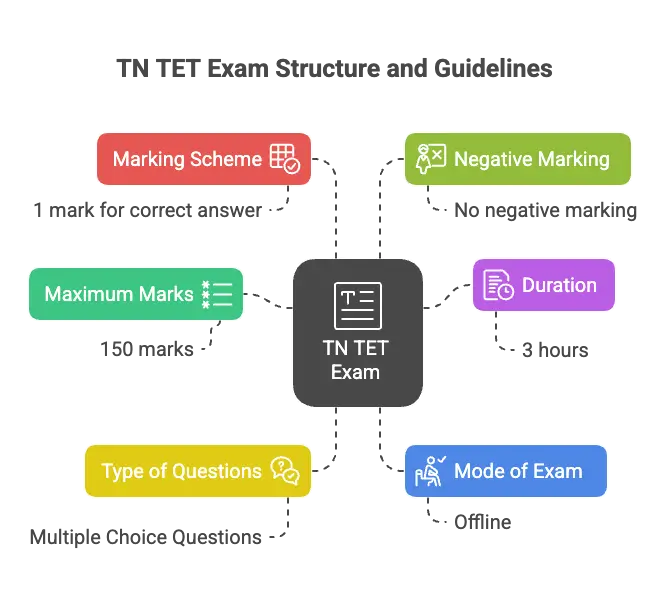
| Maximum Marks | 150 marks (for each paper) |
| Duration of TN TET Exam | 3 hours (for each paper) |
| Type of Questions | Multiple Choice Questions |
| Mode of Exam | Offline |
| Marking Scheme | 1 mark for each correct answer |
| Negative Marking | No negative marking for wrong answers |
| Official website | https://trb.tn.gov.in/ |
TNTET Notification 2026 Out for Working Teacher- Click to Check
TNTET Syllabus 2026
There will be two papers for TN TET, Paper 1 for classes 1 to 5th and Paper 2 for classes 6th to 8th. The aspirants can check the detailed information regarding the syllabus and exam pattern in this article. The description of the TNTET 2026 Syllabus for paper 1 and paper 2 is as follows.
TN TET Paper 1 Syllabus 2026
The TN TET Paper 1 Syllabus 2026 includes the subjects of Child Development and Pedagogy, Language, Mathematics, and Environmental Studies. Let's have a look at the TN TET Syllabus 2026 for the Primary Stage (Classes I-V ):
| TN TET Paper 1 Syllabus 2026 |
Child Development and Pedagogy (Focus on the Educational Psychology of Teaching and learning, the age group of 6 – 11 years. Part A - Child Development
Part B – Learning
|
Language-I (The candidate has to choose any one of the languages ( Tamil/ Telugu/ Malayalam/ Kannada/ Urdu).)
|
Language II – English will focus on the elements of language, communication and comprehension abilities.
|
| Syllabus of the State for Classes 1st to 5th |
TNTET Paper 1 Topic-Wise Priority
The priority levels below are preparation recommendations, not official topic-wise weightage.
Child Development and Pedagogy
| Topic | Priority | What to Focus On |
| Child Growth and Development | Very High | Stages of development and individual differences |
| Learning and Pedagogical Processes | Very High | Learning theories and classroom applications |
| Inclusive Education | Very High | Diverse learners and inclusive teaching practices |
| Intelligence and Individual Differences | High | Types of intelligence and learner needs |
| Motivation and Learning | High | Factors influencing learning and motivation |
| Assessment and Evaluation | High | Assessment methods and learning outcomes |
| Classroom Management | High | Teacher-learner interaction and classroom situations |
Mathematics
| Topic | Priority | What to Practise |
| Number System and Basic Operations | Very High | Number properties and calculations |
| Arithmetic and Word Problems | Very High | Fractions, decimals, percentages and everyday problems |
| Geometry | High | Shapes, angles and their properties |
| Measurement | High | Length, weight, capacity, time and units |
| Mathematics Pedagogy | Very High | Teaching methods, misconceptions and assessment |
| Data Handling | High | Tables, graphs and interpretation |
| Problem-Solving Strategies | High | Reasoning and application-based questions |
Environmental Studies (EVS)
| Topic | Priority | What to Focus On |
| Family and Community | High | Relationships, occupations and social surroundings |
| Food and Health | Very High | Food sources, nutrition and healthy habits |
| Water | Very High | Sources, uses, conservation and water-related issues |
| Plants and Animals | Very High | Habitats, characteristics and interdependence |
| Environment and Pollution | High | Conservation and environmental protection |
| Travel and Transport | Moderate–High | Different modes and their uses |
| EVS Pedagogy | Very High | Activities, observation, field visits and experiential learning |
TNTET Paper 2 Syllabus 2026
The TNTET Paper 2 exam tests a candidate based on the candidate's knowledge in Child Development and Pedagogy and Mathematics & Science / Social Studies & Social Science, Language I & II. Check the topic-wise TNTET Paper 2 Syllabus 2026 from the table below.
| TNTET Paper 2 Syllabus 2026 |
Child Development and Pedagogy (Focus on the Educational Psychology of Teaching and learning, the age group of 11-14 years.)
|
Language-I ( The candidate has to choose any one of the languages ( Tamil/ Telugu/ Malayalam/ Kannada/ Urdu).)
|
Language II – English will focus on the elements of language, communication and comprehension abilities.
|
Mathematics and Science
Social Science
|
| Syllabus of the State for Classes 6th to 8th |
TNTET Paper 2 Topic-Wise Priority
Paper 2 includes three compulsory 30-mark sections and one 60-mark subject section. Candidates should choose their subject-specific preparation strategy according to the applicable teaching category.
Child Development and Pedagogy (Classes 6–8)
| Topic | Priority | What to Focus On |
| Human Growth and Development | Very High | Adolescent development and individual differences |
| Cognitive Development | Very High | Thinking, reasoning and learning |
| Learning Theories | Very High | Applying theories to classroom situations |
| Motivation and Group Dynamics | High | Learner engagement and group learning |
| Intelligence and Creativity | High | Individual abilities and creative thinking |
| Personality and Assessment | High | Personality, evaluation and learner assessment |
| Inclusive Education | Very High | Diverse learning needs and classroom inclusion |
| Guidance and Counselling | High | Student support and developmental concerns |
Language I and Language II (English)
| Topic | Priority | Preparation Focus |
| Reading Comprehension | Very High | Understanding passages and drawing conclusions |
| Grammar | High | Grammar rules and correct usage |
| Vocabulary | High | Word meanings and contextual usage |
| Language Learning and Acquisition | Very High | How learners develop language skills |
| Language Teaching Methods | Very High | Classroom approaches and teaching strategies |
| Language Skills | High | Listening, speaking, reading and writing |
| Assessment of Language Learning | High | Evaluating language proficiency |
| Remedial Teaching | High | Identifying and addressing learning difficulties |
Mathematics and Science: Paper 2
| Subject Area | Priority | What to Focus On |
| Number System and Arithmetic | Very High | Number properties and numerical applications |
| Algebra | Very High | Expressions, equations and patterns |
| Geometry | High | Shapes, angles and geometrical concepts |
| Measurement | High | Units, area, volume and practical applications |
| Physics Concepts | High | Force, motion, light, heat and electricity as prescribed |
| Chemistry Concepts | High | Materials, substances and everyday chemical processes |
| Biology and Life Science | Very High | Living organisms, human body and life processes |
| Mathematics Pedagogy | Very High | Problem-solving, misconceptions and assessment |
| Science Pedagogy | Very High | Experiments, observation and inquiry-based learning |
Social Science: Paper 2
| Subject Area | Priority | What to Focus On |
| History | Very High | Major historical periods, events and developments |
| Geography | Very High | Physical geography, resources and human-environment relationships |
| Civics and Political Science | Very High | Constitution, government and democratic institutions |
| Economics | High | Basic economic concepts and livelihoods |
| Social Science Pedagogy | Very High | Discussion, projects, maps and source-based learning |
| Map-Based Learning | High | Places, regions and geographical interpretation |
| Contemporary Social Issues | Moderate–High | Concepts included in the prescribed syllabus |
TNTET Syllabus 2026 PDF
Before getting started with the exam preparation for the Tamil Nadu Teacher Eligibility Test (TNTET), candidates should review the TN TET Syllabus. To assist candidates here, we have shared the direct link to download the TNTET Syllabus 2026 PDF for the Paper 1 and 2 exams.
| Paper | Syllabus PDF |
| Paper 1 | Click to Download |
| Paper 2 | Click to Download |
TNTET Exam Pattern 2026
After checking the syllabus, Candidates can also check the TNTET exam pattern 2026. The TNTET exam is divided into two papers. Both papers are conducted separately and consist of 150 questions and the exam duration of each paper is 3 hours. There is no negative marking for incorrect or blank answers. TNTET 2026 marks distribution for Paper 1 and Paper 2 is given below in the tabulated form.
TNTET Paper 1 Exam Pattern 2026
The TNTET Paper 1 exam consists of objective-type multiple-choice questions. There are a total of 150 MCQ questions for a total of 150 marks in Paper 1. The duration of the exam is 03 hours. The paper 1 exam will be held for the primary level teacher posts.
| TNTET Paper 1 Exam Pattern 2026 | |||
| Content (All Compulsory) | MCQs | Marks | Medium |
Child Development and Pedagogy (relevant to the age group of 6 – 11 years) | 30 | 30 | Tamil/English |
Language-I Tamil/Telugu/Malayalam/Kannada/Urdu | 30 | 30 | |
| Language II – English | 30 | 30 | |
| Mathematics | 30 | 30 | Tamil/English |
| Environmental Studies | 30 | 30 | Tamil/English |
| Total | 150 | 150 | |
TNTET Paper 2 Exam Pattern 2026
The TNTET Paper 2 exam will be held for the upper primary-level teacher posts. The topics included in the Paper 2 exam are Child Development and Pedagogy, Language, and subject-related papers. The Paper 2 exam consists of a total of 150 multiple-choice questions for a total of 150 marks. The duration of the exam will be 03 hours. Check the TNTET Exam Pattern 2026 for Paper 2 from the table below.
| TNTET Exam Paper 2 Pattern 2026 | |||
| Content | MCQs | Marks | Medium |
| Child Development and Pedagogy (Compulsory) | 30 | 30 | Tamil/English |
Language 1: Tamil/Telugu/Malayalam/Kannada/ Urdu (Compulsory) | 30 | 30 | |
| Language II – English (Compulsory) | 30 | 30 | |
a) For Mathematics and Science Teacher: Mathematics and Science or b) For Social Science Teacher: Social Science or c) For Any other Subject Teacher | 60 | 60 | Tamil/English |
| Total | 150 | 150 | |
TNTET Previous Year Question Papers- Click to Download
TNTET Cut Off Marks- Click Here to Check